Tuesday, August 19, 2025
Wednesday, August 13, 2025
The Blue Kiełbasa Van of Kraków
The sun is drawing to an end as long shadows are cast across the street. My wife and I leave our hotel on Józefa Sarego Street and walk along the border of the Kazimierz District, a walk that has become very familiar these last four days. I relish the moment, knowing it will be my last on this sidewalk. We cross beneath the train tracks and arrive at the corner of Grzegórzecka Street. I have one final wish while in Kraków, and that is to visit the blue kiełbasa van.
I read about it online. Some guy shows up every evening between 8:00 pm and 2:00 am in a blue Nysa van and grills up kiełbasa sausages. He's so popular that crowds line up to buy.
We arrive at the spot and as expected there is a short line for the savory links of meat. There, parked on the sidewalk, is the famous blue van. Nysa vans are a relic from the communist era in Poland. They were produced in the city of Nysa and production reached its peak in the late 1970's. When Poland became a democracy the demand for the Nysa began to plummet as the people preferred the safer and more efficient western cars.
An older man with a gray stubble beard and blue ball cap stands outside the van holding two skewers loaded with sausages over an open flame. Next to him are crates full of wood to stoke the fire. I notice that attached to the van is a retracted canopy he can pull out for shelter if it starts to rain. On this evening the skies are mostly clear.
I stand in line and watch the old man as he turns the skewers over the fire, the sausages sizzling and becoming darker. A younger guy moves in and out of the van, assisting the old man. I hear chatter among the people in front of me in line, and between the two kiełbasa men, and I understand none of it.
A few feet away from the van stands a tall folding table with a wooden top and no chairs. With my new meal in-hand, I walk over to the table and begin to eat with six other strangers. This is a bizarre, but interesting experience. I don't know where anyone is from because no one is speaking. We all eat in silence.
The sun has set and the lights of Krakow now illuminate the streets. A blue tram comes down the road and inside I see rows of weary travelers, heads down, waiting for their destination.
On the window of the van a menu is posted. There are only five items: kielbasa and roll, 17 złoty; kielbasa (only), 15 złoty; orange drink, 5 złoty; tea, 5 złoty; and packaging (to go), 1 złoty. Of course, it's all in Polish, but I am able to understand.
I stand in line and watch the old man as he turns the skewers over the fire, the sausages sizzling and becoming darker. A younger guy moves in and out of the van, assisting the old man. I hear chatter among the people in front of me in line, and between the two kiełbasa men, and I understand none of it.
The line moves quickly and it doesn't take long before I'm at the front. In basic English (of which he understands), I point to the top menu item and say, “Kiełbasa and roll.” I give him 17 złoty and in return he places one perfectly charred kiełbasa onto a flimsy plate with a kaiser roll and a dollop of mustard.
A few feet away from the van stands a tall folding table with a wooden top and no chairs. With my new meal in-hand, I walk over to the table and begin to eat with six other strangers. This is a bizarre, but interesting experience. I don't know where anyone is from because no one is speaking. We all eat in silence.
With a plastic knife and fork I cut off a thick slice of kiełbasa and dip it into the mustard. It is still hot from the flames and very smokey. The outer edge is crispy and slightly tough, while the middle is thick and meaty, much more dense than the kiełbasa sausages sold in the States. I then follow it with a bite of bread.
I am hungry enough I have no problem finishing off the 8-inch long sausage. It is well worth all 17 złoty I paid for it. I now wish I would have bought the orange drink.
The sun has set and the lights of Krakow now illuminate the streets. A blue tram comes down the road and inside I see rows of weary travelers, heads down, waiting for their destination.
Jenelle and I have 20 złoty left and set out to find some ice cream or some other Polish treat. Tomorrow we will leave for good, so we need to spend what we have. It is a perfect ending to a pleasant stay in Kraków. ♠
Labels:
food,
Krakow,
Poland,
street food
Location:
Grzegórzecka 4, 31-530 Kraków, Poland
Tuesday, August 5, 2025
Goat Gate Cemetery, Bratislava
Worn down from jet lag, we had just arrived in the capital of Slovakia. Jenelle wanted to rest for a couple hours at our hotel so I took advantage of the time to hunt down a cemetery.
My first impressions of Bratislava came during the 10-minute walk to the cemetery. The streets were lined with dingy four-story apartment buildings, probably relics of the Communist era. There was a smattering of graffiti, as well as occasional strips of grass. Away from the historical center, the ambiance here was a peaceful one, with only a handful of pedestrians.
When I arrived at the cemetery on Palisády Street, I found the graveyard locked behind an iron fence. I could see the canary-colored farewell chapel with its rose window, but couldn't find a way to get inside.
Discouraged, I began to walk around the cemetery in a clockwise manner, first along Bradlianska Street. On my left were more apartment buildings, while on my right, the drab cemetery wall. My mind considered what it might have looked like during the late 1700's when this cemetery likely stood alone, beyond the walls of Pressburg. From time to time I found a gap or hole in the wall and peered inside to see the jumble of tombs.
![]() |
| Farewell chapel within the walls of Goat Gate Cemetery. |
Discouraged, I began to walk around the cemetery in a clockwise manner, first along Bradlianska Street. On my left were more apartment buildings, while on my right, the drab cemetery wall. My mind considered what it might have looked like during the late 1700's when this cemetery likely stood alone, beyond the walls of Pressburg. From time to time I found a gap or hole in the wall and peered inside to see the jumble of tombs.
When I had nearly completed the loop and had already given up hope of entering the cemetery, I arrived at the true entrance on Šulekova Street. What a relief!
I entered a world filled with trees of all varieties, and old tombstones taller than myself. In spite of the motorized roads around the cemetery, the world within its walls was peaceful and quiet.
I wandered among the graves, which appeared to be laid out in random patterns. Headstones came in a variety of designs, with different styles and motifs. Some were in the shape of a cross, while many came accompanied with statues. Some appeared to contain the carving of a skull.
![]() |
| Giant tombstones. |
![]() |
| Interesting statue and headstone. Notice the little skull. |
![]() |
| Youth making a peaceful walk through Goat Gate Cemetery. |
I wandered among the graves, which appeared to be laid out in random patterns. Headstones came in a variety of designs, with different styles and motifs. Some were in the shape of a cross, while many came accompanied with statues. Some appeared to contain the carving of a skull.
Although I am not an expert in all languages, the headstones appeared to have writing in Slovak, German, and probably Hungarian, likely representing the different people and rulers over the last couple centuries. Within this burial ground were artists, inventors, architects, lawyers, historians, merchants, clergymen, soldiers, and politicians.
Cintorín Kozia Brána, or literally translated from Slovak as “Goat Gate Cemetery,” was established in 1783. Originally, the growing Lutheran population of Pressburg (the old name of Bratislava) built a cemetery just outside the city walls. Emperor Joseph Ⅱ made a declaration that all cemeteries would have to be further away from the population centers for hygienic reasons. As a result, the Lutherans purchased land at the current location for a new cemetery. It received its name because it was built along the road that led from the Goat Gate (of the old city walls) toward the hills of the Little Carpathian Mountains.
![]() |
| Dr. Cyril Daxner: Nationalist, lawyer, Slovak officer and church official, hero of the Little War, participant in the resistance against German Nazism. |
Cintorín Kozia Brána, or literally translated from Slovak as “Goat Gate Cemetery,” was established in 1783. Originally, the growing Lutheran population of Pressburg (the old name of Bratislava) built a cemetery just outside the city walls. Emperor Joseph Ⅱ made a declaration that all cemeteries would have to be further away from the population centers for hygienic reasons. As a result, the Lutherans purchased land at the current location for a new cemetery. It received its name because it was built along the road that led from the Goat Gate (of the old city walls) toward the hills of the Little Carpathian Mountains.
Several expansions have been made over the years, leading to some of the chaos in the layout of the graves. The cemetery was officially closed in 1950, although there have been burials since then by those who already owned plots. There are 4,000 graves in the cemetery, but taking into consideration that several of the graves have been used several times over, some estimates put the number of deceased at 20,000.
I found it interesting that many graves abutted the outer wall. Many of these outer graves used the wall as a headstone, each with their own design, thus creating a tapestry of styles.
For being an older cemetery, the grounds and graves were very well-kept and clean. Although I didn't see many people, there were some who came in for a stroll to enjoy the peaceful spirit.
![]() |
| Inner wall of cemetery used as headstones. |
![]() |
| Who knew that Freddy Kruger was buried here? |
![]() |
| Example of a German headstone. |
For being an older cemetery, the grounds and graves were very well-kept and clean. Although I didn't see many people, there were some who came in for a stroll to enjoy the peaceful spirit.
As could be expected when walking through a foreign cemetery, I didn't know any of the people buried there. Although there was one who was later brought to my attention.
On the south side of the cemetery is a mausoleum dedicated to the family of Baron János Jeszenák. János was a former governor and a participant in the Hungarian resistance during 1848 and '49. As a result, he was executed in Budapest on October 10, 1849. It wasn't until 1867 that his remains were exhumed and brought to his homeland, where this former traitor became a national hero.
![]() |
| Grave of Janos Jeszenak. |
![]() |
| A wing of the mausoleum for the Jeszenak family. |
![]() |
| Russian Orthodox Cross inside of a cross. |
On the south side of the cemetery is a mausoleum dedicated to the family of Baron János Jeszenák. János was a former governor and a participant in the Hungarian resistance during 1848 and '49. As a result, he was executed in Budapest on October 10, 1849. It wasn't until 1867 that his remains were exhumed and brought to his homeland, where this former traitor became a national hero.
As I finished walking through the old burial ground, I wondered how many more stories were entombed below the ground, never to resurface in this lifetime. I thought not only of the noble, but also of the common people concealed beneath the lush, green ground of the cemetery. What kind of stories did they have? ♠
Thursday, July 24, 2025
Morskie Oko
I've been looking forward to this excursion for years now, and today was finally the day it would happen. Would it go as planned, or would weather or something else put a damper on our day?
We took a shuttle from Zakopane to Palenica Białczańska, the starting point for our jaunt into the High Tatra Mountains of Poland. Our destination, Morskie Oko, was five miles away, and there were only two ways to get there: on foot, or by horse-drawn wagon. We chose the latter.
Of course, we had to pay a steep fee for that option⸺200 złoty⸺but Jenelle's back still hurt from her surgery and we didn't want her worn out by having to walk up the mountain.
The path to the lake is paved and the vast majority of people walk it. And there are thousands of them! Young, old, partially crippled, mothers with strollers. It's like a long line of ants on a 5.6 mile path.
We, on the other hand, waited for over an hour for our turn to ride the horses. We weren't going to ride the horses directly, but were to sit in a covered wagon pulled by two horses. The problem was that only so many people could ride in a wagon at once.
When a team of horses completed the circuit, we would have to wait for them to take a break, drink, eat, and get pampered by their owners. This was quite a tiresome job for them, and they couldn't continue the loop without a rest. Although there were many teams on duty for work, it was a slow process to rotate through them.
Our driver of the wagon dressed in traditional Polish attire, with a brown leather hat and gray sweater. As we moved up the road, the horses' hooves clacked on the pavement. Their tails swooped back and forth, and the fresh scent of manure mixed with cold mountain air.
![]() |
| Riding in a horse-drawn wagon to Morskie Oko. |
Our driver of the wagon dressed in traditional Polish attire, with a brown leather hat and gray sweater. As we moved up the road, the horses' hooves clacked on the pavement. Their tails swooped back and forth, and the fresh scent of manure mixed with cold mountain air.
We passed two brown does feeding off the road, then small rivulets of water coming down the green slopes. As we got higher we passed a much larger waterfall.
I felt sorry for the horses. Their job was to pull a wagon full of people up a tediously inclining road, and sometimes at a trot. When we passed other teams coming down, I saw sweat on their flanks.
![]() |
| Waterfall along the way. |
I felt sorry for the horses. Their job was to pull a wagon full of people up a tediously inclining road, and sometimes at a trot. When we passed other teams coming down, I saw sweat on their flanks.
As we got higher on our route, views of the craggy peaks of the Tatras became more splendid. Streaks of snow in the gulleys of the upper slopes still lingered from winter.
At last, after a 3.8 mile ride, our adventure on the horses came to an end and it was now up to us to walk the remaining mile or so up to the lake. In true European fashion, an ice cream shack and restaurant stood beside the road to serve us. Not now. Maybe on the way back.
When we arrived at the lake, the view was just as spectacular as I had anticipated: a beautiful deep-blue pool of water surrounded by majestic mountains. Hundreds of people loitered about the edges of the lake admiring the view and taking selfies. Near the shore was a large wooden “hut” where hungry hikers could buy a sandwich and beer.
![]() |
| Morskie Oko. |
When we arrived at the lake, the view was just as spectacular as I had anticipated: a beautiful deep-blue pool of water surrounded by majestic mountains. Hundreds of people loitered about the edges of the lake admiring the view and taking selfies. Near the shore was a large wooden “hut” where hungry hikers could buy a sandwich and beer.
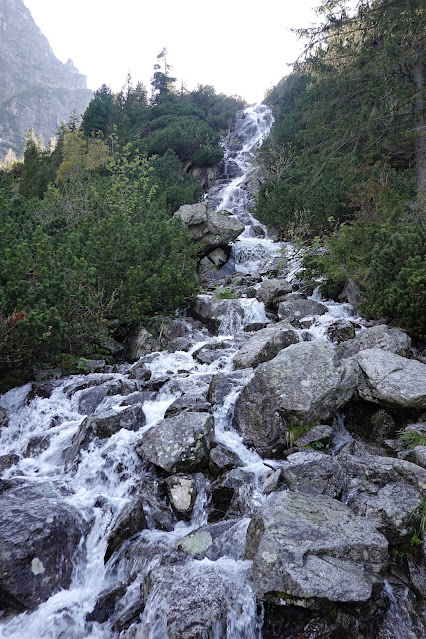
After a few quick pictures we moved around to the eastern edge of the lake. A trail made with relatively flat mountain rocks made a circuit completely around the lake. We enjoyed the view as we hiked. A handful of waterfalls tumbled into the lake from random points, most likely from melting snow and springs.
Morskie Oko, the name of this beautiful lake, comes from Polish meaning “eye of the sea.” It has been recognized as one of the most beautiful lakes in the world.
![]() |
| Swiss pines grow along east side of Morskie Oko. |
Morskie Oko, the name of this beautiful lake, comes from Polish meaning “eye of the sea.” It has been recognized as one of the most beautiful lakes in the world.
It's about half a mile to the back side of the lake, and it is from here that another trail climbs nearly 600 feet to another lake. This one is named Czarny Staw pod Rysami, or "Black Lake Below Mount Rysy" when translated into English. By this time, Jenelle was doing better than expected, so we decided to make it a go to the upper lake.
The trail was steep and tedious, but was made bearable by elevated views of Morskie Oko, as well as a cascading stream that tumbled down alongside the trail. I was proud of Jenelle. She was doing much better than either of us expected.
![]() |
| Sign on south side of Morskie Oko. |
![]() |
| Looking down at Morskie Oko from the trail going up to Czarny Staw. |
![]() |
| Cascading stream coming down from Czarny Staw. |
The trail was steep and tedious, but was made bearable by elevated views of Morskie Oko, as well as a cascading stream that tumbled down alongside the trail. I was proud of Jenelle. She was doing much better than either of us expected.
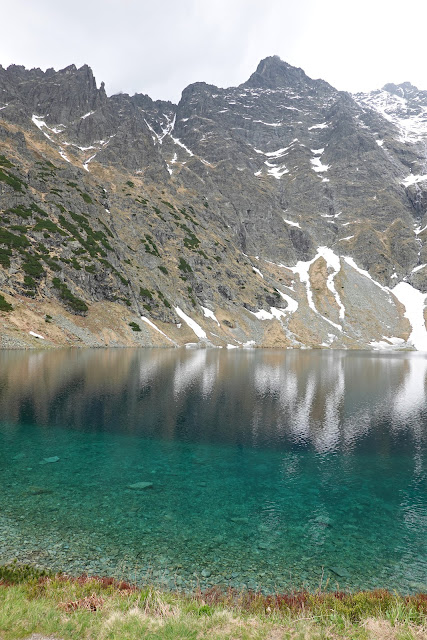
Half an hour later we arrived at the second lake, and what a wonderful view it was! Not only did we have the grand view of Morskie Oko, but now the full view of Czarny Staw. Unlike the lower lake, this one was more transparent and had a turquoise ring around it when the sun was out. The center, however, was a dark blue, probably the reason for the lake's name. At 249 feet, it is the fourth deepest lake in Poland. Mount Rysy, the highest peak in Poland, reigns supreme above it.
The craggy ridgeline on either side of Rysy serves as the boundary between Poland and Slovakia. If circumstances were different, meaning I were here alone and it was later in the summer, I would have hiked Rysy. Apparently hundreds do it every day during the latter part of the summer. It is a steep ascent, but there are cables to assist the climber.
![]() |
| Czarny Staw pod Rysami, or "Black Lake Below Mount Rysy" in English. |
![]() |
| Mount Rysy, above Czarny Staw, is the highest peak in Poland. |
![]() |
| Hikers enjoy the shore of Czarny Staw. |
The craggy ridgeline on either side of Rysy serves as the boundary between Poland and Slovakia. If circumstances were different, meaning I were here alone and it was later in the summer, I would have hiked Rysy. Apparently hundreds do it every day during the latter part of the summer. It is a steep ascent, but there are cables to assist the climber.
We spent nearly forty five minutes at Czarny Staw. It was enjoyable to watch the groups of hikers as they lounged around and rested. I was very pleasantly surprised that it hadn't rained. Juicy storm clouds threatened, but with no success. I was worried that by this time we would have been deploying umbrellas and fighting slippery rocks.
The way down was much easier than the trip up. We decided to complete the circuit and take the west side of Morskie Oko. We didn't take nearly as many pictures, so it went a lot faster.
![]() |
| Natural platform between Morskie Oko and Czarny Staw. |
The way down was much easier than the trip up. We decided to complete the circuit and take the west side of Morskie Oko. We didn't take nearly as many pictures, so it went a lot faster.
Hiking on the west side gave us new views of the lake and mountains. We enjoyed walking across the base of one of the waterfalls. There I refilled my water bottle.
When we completed our hike around the lake and again returned to the hut, we had accumulated 3.7 miles. Jenelle was still doing great. Adrenaline must have been kicking in.
![]() |
| Looking across the lake at "the hut." |
![]() |
| Waterfall tumbling into Morskie Oko. |
![]() |
| Looking back across Morskie Oko toward Czarny Staw (not seen) and Mount Rysy. |
![]() |
| Looking northeast across Morskie Oko. |
When we completed our hike around the lake and again returned to the hut, we had accumulated 3.7 miles. Jenelle was still doing great. Adrenaline must have been kicking in.
Our plan was to hike down instead of taking the horse and wagon. I was excited for this. It was an opportunity to see the mountainside at a slower pace.
We stopped at the lower hut and ordered an ice cream and pannini. It really hit the spot! We sat at a table and watched the hikers on the road.
Then we continued. We took note of the thick, fairy-like forest with moss growing on the logs. Jenelle noticed the thousands upon thousands of scrape marks in the pavement where horses' hooves clanked across the top.
![]() |
| Eating a snack at a hut about a mile down from the lake. |
Then we continued. We took note of the thick, fairy-like forest with moss growing on the logs. Jenelle noticed the thousands upon thousands of scrape marks in the pavement where horses' hooves clanked across the top.
From time to time we would hear the clapping on the pavement behind us, then would turn around and watch a team and wagon come along full of people. One wagon was singing a song as they passed.
I was most impressed with the sheer amount of people walking the trail, especially families with young kids. One set of parents hauled up little scooters, then once at the top, let their two little girls⸺no older than four years old⸺ride them down. Several parents pushed strollers. It was a level of commitment that I have rarely seen in the States.
![]() |
| Beautiful forest in the High Tatra Mountains. |
I was most impressed with the sheer amount of people walking the trail, especially families with young kids. One set of parents hauled up little scooters, then once at the top, let their two little girls⸺no older than four years old⸺ride them down. Several parents pushed strollers. It was a level of commitment that I have rarely seen in the States.
Five point four miles later we had made it to the bottom! Our total for the day was 9.1 miles. Luckily for us there was a line of shuttles waiting at the bottom to take us back to Zakopane. ♠
Labels:
Carpathian Mountains,
Europe,
High Tatra Mountains,
mountains,
Poland,
Zakopane
Location:
Morskie Oko, Poland
Subscribe to:
Posts (Atom)


