Monday, June 26, 2023

Oracle Park


I didn't think we were going to make it on time after trying to navigate the San Francisco public transportation system. I couldn't even buy a ticket and there were no employees in the station! But we managed to figure it out and after another transfer made possible by a nice old gentleman, we were on our way! 

Now we were on a packed subway car mixed with Dodger and Giants fans. All stood side by side, donning their jerseys and caps. It was a display of pride and loyalty. 

Fans crammed inside a subway car.

We don't go to professional ballgames very often. We live too far away. Anytime we do it's a novelty and I relish every moment. Personally, I prefer baseball over other sports. There is a sense of national pride and tradition that makes it meaningful to me. 

We stepped off the train and instantly stood in the midst of the action. Long lines stood to buy tickets or enter the gates. Aroma from vendors grilling fat hotdogs floated through the air. Some people, including myself, admired the statue of Willie Mays, directly in front of the main entrance. There were other statues located around the ballpark, including greats such as Willie McCovey, Orlando Cepeda, Gaylord Perry and Juan Marchial. I would have loved to have walked around the park and looked at each one, but our fiasco with the train system delayed us so much that we didn't have time. 

The Willie Mays Gate at Oracle Park.

Vendors selling hot dogs outside the park.

Statue of Willie Mays.

We entered the Willie Mays Gate and walked up a series of long ramps, shoulder to shoulder with thousands of others. We searched for our seats which were behind third base, but on the upper deck. Finally we found our entry, just as a booming Pavarotti voice sang the National Anthem. 

The view from our seats was amazing! From our perch we could see nearly the entire stadium and beyond. Behind right field was San Francisco Bay where we could see boats and all the way to Oakland. The right-field wall was distinct, made with bricks and arches to resemble the old Polo Grounds in New York. 

Oracle Park in San Francisco, California.

The family.

I remember watching ballgames on television as a kid, and especially those at Candlestick Park here in San Francisco. It was also located on the bay, close enough that small boats could wait beyond the fence for a home run to be hit. At that time I made it a goal to some day make it to Candlestick. Of course, that didn't happen and they tore it down. But its replacement, Oracle Park, felt just as spectacular. 

Oracle Park first saw action in 2000, and over the years has had several different names. It has a capacity of 41,915. The deepest part of the field is right-center, where it is a whopping 415 feet from home plate. This section is called “triples alley” due to the bad bounces that tend to happen here. 

Levi's Landing in right field resembles the brick wall at the Polo Grounds in New York.

The game started with a banger when Mookie Betts for the Dodgers had a lead-off home run. I haven't followed the sport very well for years, but Mookie Betts was one of the few names that sounded familiar. Although it came from the visiting side, the crowd lit up with excitement. Dodger fans seemed to be as well represented as those from the Giants. 

The starting pitcher for Los Angeles was Julio UrĂ­as, a Mexican-born player whom I had never heard of. Right away I could see that he was good. He was a lefty, so we watched from the backside as he wound up and lifted his right leg.  I was fascinated with how he twisted his torso, almost to face the batter. Then he would unwind, releasing his energy with a long stride toward home plate, and deliver a 95 mph fastball. He was very good and the Giants found it difficult to get on base. 

Julio Urias, a Mexican-born pitcher for the Dodgers.

Even if you're not a baseball fan, it is exciting to attend a Major League ballgame for the environment alone—especially with a large and enthusiastic crowd. This one didn't disappoint. I think that anytime a team from Los Angeles travels, they are hated and draw strong emotion. During this game, the chant “Beat L.A.” emerged multiple times. Of course, that didn't settle too well for the many Dodger fans in the stadium. The group behind us started their own parody of the chant: “East L.A., East L.A.!” I couldn't help but to lean back and smile. 

One goal of mine was to buy everyone in the family a ridiculously expensive snack from the concessions. For myself, I chose one of the big fat Polish hotdogs that I saw others eating. It was so big it barely fit in my mouth. They topped it with a plethora of diced peppers and onions. Even though it was a mess, it was worth every dollar. 

As I previously mentioned, I don't keep up with baseball well enough to be familiar with many of the players. But one name for sure struck me—Yastrzemski. Mike Yastrzemski is the grandson of Hall of Famer, Carl Yastrzemski. The younger plays right field for San Francisco. Although there was nothing spectacular about his play on this night (he was only 1 for 4), it was fascinating to watch him, knowing that greatness was in his blood. 

Mike Yastrzemski, grandson of Hall of Famer, Carl Yastrzemski.

By now the sun had set behind us into the depths of the Pacific Ocean, and stadium lights came on. The bay was completely black except for a few lights from the boats. A mist of rain swept through from time to time, but not enough to dampen anything. By this time the Giants were slipping further behind, needing a miracle if they were to have a chance. 

Then came the top of the seventh when Max Muncy (another guy I've never heard of) walloped a grand slam over the left field fence. This was the nail in the coffin. L.A. was now up 9 to 1. Some of the more sensible Giants fans began to file out to get a head start on the post-game rush. 

We, however, stayed until the end. I was going to relish every minute of it. We sat in open-air with the smell of the bay drifting in. There was still an excitement in the air, even though the home team was about to lose. The chants of “Beat L.A.” were nowhere to be heard. 

It was a madhouse after the final pitch. I didn't think we'd make it out without something happening to us. But somehow we made the train. Once again, Dodger and Giants fans, now beleaguered, stood side by side on a crowded subway car. ♠


A spectacular evening at Oracle Park in San Francisco.


Sunday, June 4, 2023

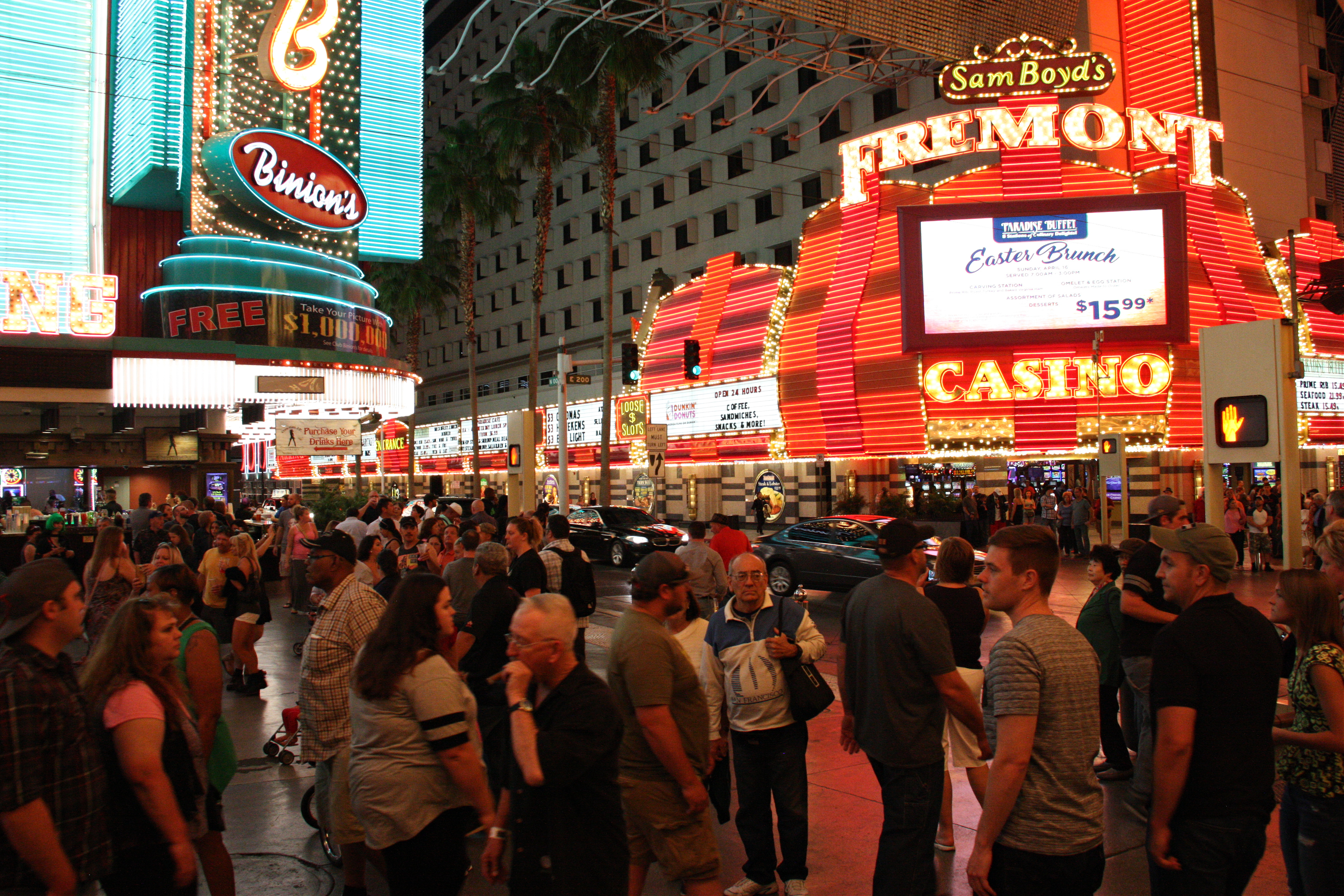
Fremont Street


I've often wondered what my grandpa Lacy would think of Fremont Street if he were still alive. 

When I was younger, my brother and I spent some time with him and my grandma in Las Vegas. We occasionally ventured into Downtown. This was the older section of town, with a rougher, more stacked-together feeling than The Strip. I remember eating breakfast at Binion's Horseshoe, where our plate came with a ham steak that poured off the edges, a pile of hash browns, runny eggs, and toast over which my brother poured Tabasco sauce. 

Afterward we crossed the street and Grandpa walked us through the Golden Nugget. He showed us a display case which housed a large, shiny yellow stone that supposedly was the largest chunk of gold in the world. It was, for sure, the largest chunk of gold on Fremont Street. 

Grandpa was more familiar with Vegas than we were. He went there frequently to play poker. Over the years he gradually stopped making the 9-hour trip to Nevada and eventually took his game elsewhere.

That was over thirty years ago and Fremont Street has changed a lot since then. 


The street gets its name from John C. Fremont, one of three explorers who share credit with discovering the area. The other two were Antonio Armijo and his scout, Rafael Rivera, who passed through during the winter of 1829-30. But it was Fremont who put it on the map. 

During his second expedition, John C. Fremont pushed through what is now Utah and into Oregon. They returned by dropping south into California and passing through Sutter's Mill. After passing through a God-forsaken desert and enduring adventures with local Indians, Fremont and his group finally passed through the area now known as Las Vegas. 

His entry for May 3, 1844 records: 

“After a day's journey of 18 miles, in a northeasterly direction, we encamped in the midst of another very large basin, at a camping ground called Las Vegas⸺a term which the Spaniards use to signify fertile or marshy plains, in contradistinction to llanos, which they apply to dry and sterile plains. Two narrow streams of clear water, four or five feet deep, gush suddenly with a quick current, from two singularly large springs; these, and other waters of the basin, pass out in a gap to the eastward. The taste of the water is good, but rather too warm to be agreeable; the temperature being 71 in the one and 73 in the other. They, however, afford a delightful bathing place.” 

Fremont's 1845 report of this trip included maps. 20,000 copies were made and every sensible person heading west had a copy. Thus, thousands of pioneers came west feeling more confident as a result of his observations. 


Nowadays most people don't make the connection with Fremont Street and John C. Fremont, but rather conjure up images of the mob and notorious people such as Benny Binion and Tony Spilotro. This area of Sin City was once known as Glitter Gulch for all the neon lights. But behind all the sparkle were high-stake poker games and organized crime that got a blind-eye from city officials. 

I talked to a guy recently who lived in Vegas during the 1970's. He loved it! And, ironically, he said, it was the mob who kept it safe. According to him, there was very little street crime because the mob would pick off the criminals. He said that now Vegas is a lot more dangerous than it used to be when the mob was in control. 


During the 1990's Fremont Street received a drastic facelift. Due to the increasing popularity of The Strip, the Downtown area lost business and something had to be done. Consequently, the road was torn out and replaced with a pedestrian walkway. A gigantic neon canopy that spanned several blocks was stretched overhead. It was now a walker-friendly avenue that became known as The Fremont Street Experience

I was unaware of all these changes and happened upon them in the early 2000's when I took my young family to show them one of my “childhood places.” I was shocked at the new Fremont Street and not sure if I liked it or not. At that time my grandpa was still alive, although a frail old man, and I returned home to give him the report. He listened with interest, never giving an opinion one way or another. Of course, the Fremont Street I saw that day was quite mild from that which I would witness in coming years. 

Occasionally we returned as a family. My kids loved to watch the lights on the canopy overhead and people whizzing by on a zip-line. Live bands played on the walkway while my daughters and wife would dance. This place has become nostalgic for me because I recall Brittany dancing and having a blast, and this would be just a short year or two before she passed away. 


Recently, now 2022, I returned to Fremont Street with my family. I admit that the more I go, the less I want to bring the kids. It's certainly not a family-friendly place anymore. Music blared from every corner and there was not a single space devoid of noise. We saw bands and also solo artists playing for coins. 

Of course, there were the smells. The one I hated the most were the fumes of marijuana that seemed to permeate everywhere. But there was also the aroma of grilled hot dogs, street tacos and barbeque. 

Probably the biggest draw of Fremont Street is the people-watching. From freaks to showgirls, this place has it all. There are artists spray-painting their works in front of a mesmerized crowd. Magicians dazzle the audience and pull objects from thin air. Beggars stand with nothing more than an overturned hat and sign, sometimes with brutal honesty admitting that all they want is enough money to buy some weed. 


On this evening I came with my wife and three older daughters. As the years go by, I am always more hesitant to bring my kids because of all the filth. It seems to get sketchier all the time. 

We were pressed for time so we didn't stop to see much. My wife and I have been on this street about a dozen times and nothing shocks us anymore. 

There was a lot of alcohol consumption in the outdoor bars along the walkway. Consequently, there were also a lot of drunk people doing dumb things. 

We walked up and down the street looking for a place to eat that wasn't too expensive. Although not as bad as The Strip, Fremont Street is starting to catch up with its high prices. It is certainly not the street of bargain deals like when my grandpa took us to Binion's Horseshoe.⸺Tonight we ended up eating the $8.99 prime rib dinner at the Fremont. 


Afterward we had a funny experience. As I walked down Fremont Street I tried to clandestinely capture images that I could use for this blog post; pictures that spoke to the character of the place. They say a picture is worth a thousand words. 

And what would encapsulate the essence of Fremont Street? Showgirls, of course! I walked past a couple of girls with their pink feathers, high-heeled boots and wearing almost nothing else. I casually raised my camera to sneak a picture. Not only did they see me, but they smiled, posed, and then waved for me to come over! 

The next thing I knew, here was a Mormon boy carrying on a conversation with two showgirls while my wife and daughters were twenty feet away laughing their heads off! The showgirls were very nice and explained that I could have another picture with them, but they work for tips and accept credit cards if I didn't have cash. Flustered and not sure what to do, I politely declined and walked away. I had already taken my picture and hoped these girls would forgive me for not tipping them. ♠


Monday, May 22, 2023

Old Dominican Cemetery


While waiting for Jenelle to get ready I walked to the old cemetery. It is in the center of Santo Domingo on Independence Avenue and is quite picturesque with palm trees and white crosses. I walked all the way around looking for an entrance, but found the main gate locked. 

I stopped a man on the street and asked him how to enter. He asked me where I was from and I said, “Soy Americano,” then clarified I was from the United States. He smiled and said, “We are the same. I will help you!” 

We approached a gentleman on the corner sitting on a green plastic chair. He informed us the man with the keys hadn't arrived yet, but soon would come. I was very appreciative for their help, but didn't have the time to wait. 

I made another lap around the cemetery, peering through the fence every chance I could. The grounds lacked maintenance. Tall grass grew all around. Although I wasn't able to go inside, I still enjoyed great views. The few stones I was able to read came with death dates from the early 1900's. 


The first burial in the cemetery came in 1824 during the Haitian occupation. It was a 16-year old girl named Juana Flores. The histories describe her as a mulatta with dark hair that fell to her waist. Her parents were unwilling to accept her marriage to her lover, which caused Juana to fall into a deep depression. Unable to escape, she decided to take her own life and ingested a poisonous substance. The following day, August 29, 1824, she passed away. She is now known as the “Baroness” Juana Flores.

Several people are also buried here who died during the 1965 Revolution. Since that year there have been no further burials. 

The cemetery lies outside the old city walls and away from the tourist center. Few foreigners, I would imagine, ever visit the cemetery. On this day, I would have to be satisfied with a couple laps around the grounds, peering through the bars. ♠


Saturday, May 6, 2023

Rodeo at the Iron County Fair


These pictures are from the rodeo at the Iron County Fair in Parowan, Utah eight months ago. They were all taken from a single location, which was from my seat in the bleachers on the east side of the arena. The pictures are listed chronologically, which means the first ones I am shooting directly into the sun, and the latter I am using stadium lights with a high ISO and low shutter speed. 

I am nowhere near a professional photographer, but it is a passionate hobby.  Whenever I get a chance, the rodeo is one of my favorite subjects. The horses, the cowboys, the dust, the action---all make for a fun event. 

The one regret I had this evening was that I didn't get a good bull-riding picture. Unfortunately, the bull-riding event is always last when lighting is at its worst. Usually the bulls tend to stay close to the gate and nowadays the riders are obliged to wear helmets. It's difficult to get a good, clear image. And on this night, there was only one bull. My final picture is of the bull and rider in the chute, waiting for the ride. ♠


Friday, April 28, 2023

Salt Lake City Cemetery (Part 2)


The Salt Lake City Cemetery is by far the most historic graveyard in Utah. Anyone familiar with the history of the Church of Jesus Christ of Latter Day Saints will recognize numerous Apostles, Prophets, and other prominent figures. Additionally, there are hundreds of lay pioneers buried alongside their ecclesiastical leaders. Catholics and Jews also have their own sections near the Mormons. 

The cemetery covers over 150 acres and has 9 ½ miles of roads. It is one of the largest city-operated cemeteries in the United States. It lies in the Avenues of Salt Lake City, up in the foothills. The first burial was of a child, Mary Wallace, in 1849. 

The last time I visited the Salt Lake City Cemetery was in search of my own ancestor, John Workman. As far as I knew, he was my only relative buried here. But once I got home, I quickly learned I was wrong—I had four more. Now it was my turn to find the graves of Samuel and Phoebe Merrill, and John and Mary Snider. 

And there was more to explore. Last time I had barely scratched the surface of what there was to see. Jenna and I set out in early November after a doctor's appointment at the Huntsman Cancer Center. As fate would have it, we were hit with an early winter snowstorm, covering headstones and fall leaves in a blanket of wet powder. 

Samuel and Phoebe Merrill.

Grave marker for the Merrill family.

It didn't take long to find the graves of my fifth-great-grandparents, Samuel and Phoebe Merrill. A large stone monument marks the plots of several family members. Phoebe died in 1862 and Samuel sixteen years later. A son-in-law, Thomas Williams, constructed the memorial. He included two of his own children that died in 1850 and 1853, as well as a brother. 

Samuel and Phoebe were of hardy pioneer stock, having joined the church in its infancy in 1838. They were baptized by another ancestor of mine, Joel Hills Johnson. They lived in Nauvoo, Illinois and were acquainted with the prophet, Joseph Smith, with whom Samuel traded horses. After the prophet's martyr, they migrated westward with the Saints, arriving in the Salt Lake Valley in 1847. Samuel was in his late sixties at the time. Of Phoebe it was said she “had a reputation for discovering sick or discouraged people and nursing them back to good health. Her talent made her a great asset to the Church in its early years." 

Salt Lake City Cemetery.

Gravestone of Temperance Bond Mack.

One of the many headstones that caught my attention was that of Temperance Mack Bond, who had died in 1850 at the age of 79. There was something that stood out to me, but I didn't know what it was. After returning home I did some research and leaned that she was the sister-in-law of Lucy Mack Smith, mother of the prophet, Joseph. 

As far as I can tell, Temperance was the only sibling in the Mack family to make the trip west with Brigham Young and the Saints. She didn't convert to the church until in her seventies. According to her own words: “I had full confidence in Lucy Mack Smith when she told me that her son had a vision and talked to God.” 

Temperance traveled to Utah with her daughter Almira and husband, Benjamin Covey. Temperance would pass away just two years after arriving in the Salt Lake Valley, never again seeing her other children. Through her daughter, Almira, there would be many faithful members of the church brought into this world. One of her direct descendants is Stephen Covey, a famous author, businessman and motivational speaker. 

Family plot for the Hunter family.

Further up on the slopes of the cemetery, I found another memorial that caught my attention. The name “Hunter” was etched along a vertical slab of stone and it sat inside of a family plot with other markers covered in snow. Hunter is a common name in Utah, and I wondered if by chance this man was the patriarch of them all. I stepped closer to the stone to catch the full name. It was Edward Hunter, who died in 1883. 

As with most buried in this cemetery, I knew this man had numerous untold stories and descendants as the sands of the sea. A succinct biography of Edward Hunter from the website, Find a Grave, reads: “Presiding Bishop of The Church of Jesus Christ of Latter-day Saints. Baptized by Orson Hyde, he sold all his land and possessions, moved to Nauvoo, and gave all to the Prophet Joseph. He also served for some time as one of Joseph's many bodyguards. At the time of the martyrdom of Joseph and Hyrum Smith, he helped hide the bodies for fear of desecration by enemies of the Church. At the death of his dear friend Bishop Newel K. Whitney, Bishop Hunter was ordained Presiding Bishop by President Brigham Young and Apostle Heber C. Kimball. He then selected these two men as his counselors in the Bishopric. He also helped lay the cornerstone of the Salt Lake Temple.” 

Headstone of Caleb Baldwin.

I had an experience several years ago with an older gentleman on my mail route. His name was Ben Baldwin and when I asked him about his roots, he began to speak fondly of his great-grandfather, Caleb Baldwin. As he spoke, a tear came to his eye. It wasn't a tear of sadness, but of love. He spoke of his great-grandfather being a valiant and faithful man. Then he added that Caleb spent four months in Liberty Jail with Joseph Smith in 1838. During that time Joseph used him as a scribe to pen several letters to the Saints. 

As I roamed the Salt Lake Cemetery that day, I came across Caleb Baldwin's grave. A smile came to my face and I thought of Ben and the admiration he had for his grandfather. 

I also recognized the name of Caleb Haight. He died in 1851, shortly after he arrived in the valley. He was the father of Hector Haight, one of the original settlers of Farmington, Utah, as well as Isaac Haight, one of the primary culprits in the Mountain Meadows Massacre.


Grave of Caleb Haight.

Reynolds Cahoon.

The name “Reynolds Cahoon” rang familiar to me, and I knew that I had read it in the Doctrine and Covenants, a sacred book of scripture for members of the Mormon faith. In D&C 61:35 it reads: “And let them journey together, or two by two, as seemeth them good, only let my servant Reynolds Cahoon, and my servant Samuel H. Smith, with whom I am well pleased, be not separated until they return to their homes, and this for a wise purpose.” 

There's another interesting story about Reynolds Cahoon. In 1834 while living in Kirtland, Ohio, Reynolds' wife bore him a son. One day, as Joseph Smith was passing by, Reynolds called him and asked if he would bless and name his baby. The Prophet then did so and gave the name “Mahonri Moriancumer” to the child. When the blessing was over, he turned to Reynolds and told him that the name he gave his son was that of the Brother of Jared. Up until this time, the name of the Brother of Jared had been revealed to no one in the church. 

James E. Talmage.

Headstone of Apostle James E. Talmage.

The snow began to drop at a faster pace and our shoes were now becoming saturated in cold wetness as we meandered through the memorials. There, in a large stone of marble, now becoming difficult to read because of large white flakes, sat the headstone for James E. Talmage. The inscription reads: “1862 – 1933; EDUCATOR, SCIENTIST, APOSTLE; 'Within the gospel of Jesus Christ there is room and place for every truth thus far learned by man, or yet to be made known.' - J.E.T.” 

In the church, Talmage is known for authoring the influential book, Jesus the Christ. During the year of 1914 he was given a room in the Salt Lake Temple where he studied and wrote the book. It took him seven months to complete the writing and he wrote it all in longhand, using a pencil. 

Archibald Gardner, patriarch of a large family.

The headstone of Archibald Gardner caught my attention. It is well known that in the early days of the LDS Church that some members practiced plural marriage. It wasn't uncommon for a man to have two or three wives. But Archibald Gardner, judging from his headstone, had eleven! Six are buried next to him in Salt Lake while the others are buried elsewhere. 

He was born in Scotland in 1814, and died in Salt Lake in 1902. The bottom of the marker quotes a portion of his Patriarchal Blessing: “A posterity shall keep thy name in remembrance forever.” 

View of Salt Lake City Cemetery, looking north.

Burial plot of Hosea Stout.

One common theme I saw as I roamed the lawns of the cemetery was the sheer amount of pioneers who were with the Saints in the early days of the church. Another such person was Hosea Stout. He is an important person in the history of the church because of his diligent effort in keeping a daily journal. He was an eyewitness to many early events. 

Having joined the Church of Jesus Christ of Latter Day Saints just a few years after the publication of the Book of Mormon, Hosea Stout was a fiercely faithful member of the church. He had many personal assignments which gave him close contact with high-up leaders. He was one of many body guards to Joseph Smith. In 1851 he served a mission to Hong Kong, in which he dedicated the land of China to missionary work. 

Orrin Porter Rockwell.

Perhaps the most infamous burial in the cemetery is that of Orrin Porter Rockwell, also known as “The Destroying Angel.” Rockwell, who was also one of the earliest members of the church, never learned to read or write, yet he was one of the most loyal defenders of Joseph Smith. There are many stories and legends of him protecting the prophet from those who would do him harm.

He was large and powerful with long flowing hair. On Christmas of 1843, he was given a blessing by Joseph Smith that if he never cut his hair then “no bullet nor blade can harm thee.” This colorful figure in Mormon history has been the subject of numerous books and movies. It took us a while to find his grave, but it ended up being not too far from my grandparents, Samuel and Phoebe Merrill.

Porter Rockwell, one of the most notorious people buried in the cemetery.

Occasionally a headstone will literally tell a story. Such is the case of Joseph Standing, a missionary for the church who was murdered in 1879. A five-foot monument reads: “Martyred for the testimony of Jesus Christ, while with Elder Rudger Clawson, through whose heroism the body was afterward rescued, July 21st 1879, Varnell Station, Whitfield County, Georgia, by an armed mob of twelve men . . . His murderers were indicted and two of them tried, the first on a charge of murder and the other for riot. Through bigotry and prejudice, both were acquitted. Evidence of guilt was not lacking, but the assassins boasted, 'There is no law in Georgia for the Mormons.'” 


Telling headstone of Joseph Standing.

Further up on the hill, next to a narrow cemetery road, stands a very tall obelisk commemorating John Taylor and his family. He became the third President of the Church in 1880. 

A notable story of John Taylor came in 1844 at Carthage Jail. A mob of some 200 men with painted faces broke into the second floor of the jail where Joseph Smith, Hyrum Smith, Willard Richards and John Taylor were being held. Amidst a storm of gunfire, the Prophet and his brother were killed. Taylor received several bullets in his arms and legs, but there was one potentially fatal ball that struck and was stopped by the watch in his breast pocket. Although seriously wounded, John Taylor would live another forty three years to the old age of 78. 


Distant view of John Taylor's grave and family plot.


Close-up of John Taylor's headstone.

John Snider.

If you recall, I had one last grave I had to locate: that of my fifth-great-grandparents, John and Mary Snider. Being a flat stone and probably covered in snow, it was a little more difficult to find. We knew it was in section five. With a little perseverance, we finally stumbled across it. 

It is fascinating to learn how much the early pioneers were intertwined. As I studied the life of John and Mary Snider, I became aware that their entrance into the Mormon faith came alongside future prophet, John Taylor. 

In 1833, Taylor served as a Methodist minister in Toronto, Canada. He led a group called “Students of the Scriptures,” which sought an increased understanding of the truth. The Sniders were a part of this group. They were searching for a true church that had signs of the primitive church, namely prophets, apostles, evangelists and gifts of wisdom, faith, tongues, healings and other manifestations. 

About this time, Heber C. Kimball of the Quorum of the Twelve Apostles, delivered a prophecy to Parley P. Pratt that there were people in upper Canada who would receive the gospel and would be baptized. Many miracles occurred as he made his way to Toronto. Here he taught many people, including those in this small group. Eventually, John Taylor and the Sniders were baptized, which would change the course of their lives. 

Wet gravestone of John and Mary Snider.

Having now found the final resting place of John and Mary Snider, I was satisfied with our sojourn in the Salt Lake City Cemetery. Besides, our toes were becoming numb in the wet snow and we had a long drive home. 

It's always a humbling experience to walk among the graves of those who gave everything for a cause in which they strongly believed. Their lives were filled with acts of faith.  They were impoverished by worldly standards, but found deep joy in the gospel. This land I walked on was hallowed ground. ♠ 


Link: Salt Lake City Cemetery (Part 1)