Showing posts with label Claude Lacy. Show all posts

Sunday, June 4, 2023

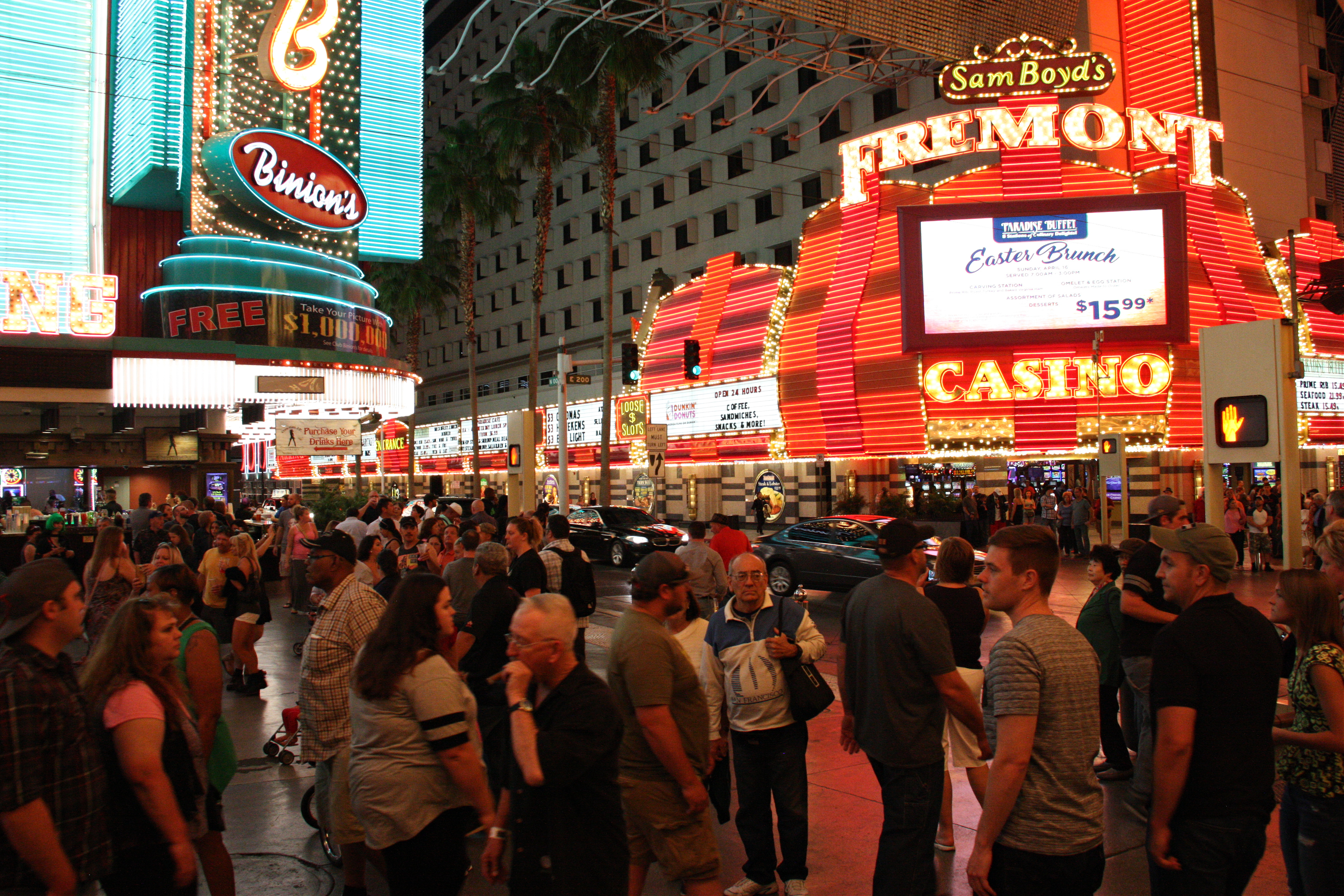
Fremont Street


I've often wondered what my grandpa Lacy would think of Fremont Street if he were still alive. 

When I was younger, my brother and I spent some time with him and my grandma in Las Vegas. We occasionally ventured into Downtown. This was the older section of town, with a rougher, more stacked-together feeling than The Strip. I remember eating breakfast at Binion's Horseshoe, where our plate came with a ham steak that poured off the edges, a pile of hash browns, runny eggs, and toast over which my brother poured Tabasco sauce. 

Afterward we crossed the street and Grandpa walked us through the Golden Nugget. He showed us a display case which housed a large, shiny yellow stone that supposedly was the largest chunk of gold in the world. It was, for sure, the largest chunk of gold on Fremont Street. 

Grandpa was more familiar with Vegas than we were. He went there frequently to play poker. Over the years he gradually stopped making the 9-hour trip to Nevada and eventually took his game elsewhere.

That was over thirty years ago and Fremont Street has changed a lot since then. 


The street gets its name from John C. Fremont, one of three explorers who share credit with discovering the area. The other two were Antonio Armijo and his scout, Rafael Rivera, who passed through during the winter of 1829-30. But it was Fremont who put it on the map. 

During his second expedition, John C. Fremont pushed through what is now Utah and into Oregon. They returned by dropping south into California and passing through Sutter's Mill. After passing through a God-forsaken desert and enduring adventures with local Indians, Fremont and his group finally passed through the area now known as Las Vegas. 

His entry for May 3, 1844 records: 

“After a day's journey of 18 miles, in a northeasterly direction, we encamped in the midst of another very large basin, at a camping ground called Las Vegas⸺a term which the Spaniards use to signify fertile or marshy plains, in contradistinction to llanos, which they apply to dry and sterile plains. Two narrow streams of clear water, four or five feet deep, gush suddenly with a quick current, from two singularly large springs; these, and other waters of the basin, pass out in a gap to the eastward. The taste of the water is good, but rather too warm to be agreeable; the temperature being 71 in the one and 73 in the other. They, however, afford a delightful bathing place.” 

Fremont's 1845 report of this trip included maps. 20,000 copies were made and every sensible person heading west had a copy. Thus, thousands of pioneers came west feeling more confident as a result of his observations. 


Nowadays most people don't make the connection with Fremont Street and John C. Fremont, but rather conjure up images of the mob and notorious people such as Benny Binion and Tony Spilotro. This area of Sin City was once known as Glitter Gulch for all the neon lights. But behind all the sparkle were high-stake poker games and organized crime that got a blind-eye from city officials. 

I talked to a guy recently who lived in Vegas during the 1970's. He loved it! And, ironically, he said, it was the mob who kept it safe. According to him, there was very little street crime because the mob would pick off the criminals. He said that now Vegas is a lot more dangerous than it used to be when the mob was in control. 


During the 1990's Fremont Street received a drastic facelift. Due to the increasing popularity of The Strip, the Downtown area lost business and something had to be done. Consequently, the road was torn out and replaced with a pedestrian walkway. A gigantic neon canopy that spanned several blocks was stretched overhead. It was now a walker-friendly avenue that became known as The Fremont Street Experience

I was unaware of all these changes and happened upon them in the early 2000's when I took my young family to show them one of my “childhood places.” I was shocked at the new Fremont Street and not sure if I liked it or not. At that time my grandpa was still alive, although a frail old man, and I returned home to give him the report. He listened with interest, never giving an opinion one way or another. Of course, the Fremont Street I saw that day was quite mild from that which I would witness in coming years. 

Occasionally we returned as a family. My kids loved to watch the lights on the canopy overhead and people whizzing by on a zip-line. Live bands played on the walkway while my daughters and wife would dance. This place has become nostalgic for me because I recall Brittany dancing and having a blast, and this would be just a short year or two before she passed away. 


Recently, now 2022, I returned to Fremont Street with my family. I admit that the more I go, the less I want to bring the kids. It's certainly not a family-friendly place anymore. Music blared from every corner and there was not a single space devoid of noise. We saw bands and also solo artists playing for coins. 

Of course, there were the smells. The one I hated the most were the fumes of marijuana that seemed to permeate everywhere. But there was also the aroma of grilled hot dogs, street tacos and barbeque. 

Probably the biggest draw of Fremont Street is the people-watching. From freaks to showgirls, this place has it all. There are artists spray-painting their works in front of a mesmerized crowd. Magicians dazzle the audience and pull objects from thin air. Beggars stand with nothing more than an overturned hat and sign, sometimes with brutal honesty admitting that all they want is enough money to buy some weed. 


On this evening I came with my wife and three older daughters. As the years go by, I am always more hesitant to bring my kids because of all the filth. It seems to get sketchier all the time. 

We were pressed for time so we didn't stop to see much. My wife and I have been on this street about a dozen times and nothing shocks us anymore. 

There was a lot of alcohol consumption in the outdoor bars along the walkway. Consequently, there were also a lot of drunk people doing dumb things. 

We walked up and down the street looking for a place to eat that wasn't too expensive. Although not as bad as The Strip, Fremont Street is starting to catch up with its high prices. It is certainly not the street of bargain deals like when my grandpa took us to Binion's Horseshoe.⸺Tonight we ended up eating the $8.99 prime rib dinner at the Fremont. 


Afterward we had a funny experience. As I walked down Fremont Street I tried to clandestinely capture images that I could use for this blog post; pictures that spoke to the character of the place. They say a picture is worth a thousand words. 

And what would encapsulate the essence of Fremont Street? Showgirls, of course! I walked past a couple of girls with their pink feathers, high-heeled boots and wearing almost nothing else. I casually raised my camera to sneak a picture. Not only did they see me, but they smiled, posed, and then waved for me to come over! 

The next thing I knew, here was a Mormon boy carrying on a conversation with two showgirls while my wife and daughters were twenty feet away laughing their heads off! The showgirls were very nice and explained that I could have another picture with them, but they work for tips and accept credit cards if I didn't have cash. Flustered and not sure what to do, I politely declined and walked away. I had already taken my picture and hoped these girls would forgive me for not tipping them. ♠


Sunday, May 12, 2019

Doing Hard Things

In modern America, an experience like that of Kumen Jones is virtually nonexistent.
 

At the age of sixteen, Kumen went to work delivering mail between Cedar City, Utah and Boullionville, Nevada, a round-trip distance of 225 miles. It was a lonesome job. He traveled by himself and spent nights with families from settlements along the way. Each trip lasted six days and he did this for three years.
 

Anyone who travels this same stretch in our modern era knows that it continues to be a desolate area. Imagine a sixteen-year old boy making this journey in the bitter cold of winter in a foot of snow—depending solely upon his own merits for survival. Even under ideal conditions, an experience like this would quickly transform a boy into a man.
 

Kumen Jones
At age nineteen he began work for a cattle company from Cedar City. He tells the story of spending the winter on the east fork of the Virgin River at a place they called “lower herd.” In February, he and a friend started back for Cedar on what was known as the “Shoonsberg Trail.” This would take them through the settlements of Shunsberg and Toquerville, and up the Black Ridge toward home.
 

They hadn't traveled far along the fork of the river when it began to snow. Soon, the trail was obliterated and the two men lost their bearings. For two days they wandered without food and the snow piled two to three feet deep. They prayed fervently, knowing the desperate situation they faced. Even their horses were exhausted.
 

Then, on the morning of the third day, the storm broke and they recognized the hills near their original starting point. At last their prayers were answered, as Kumen put it, “by the kind Father above.”
 

These experiences helped shape Kumen for the rest of his life. He went on to be a member of the infamous Hole in the Rock Expidition, where he played a key role in assisting with a seemingly impossible trek. He later helped build a city and became a leader in the community.
 

Stories like these aren't limited to Kumen Jones. After the violent death of his father and uncle, Joseph F. Smith was required to drive one of the ox teams from Montrose, Iowa to Winter Quarters, and later to the Salt Lake Valley at the age of nine. Many of my ancestors built towns from land that had scarcely been seen by white men. Say what you may about teenage marriage, but the truth is that many women married young and it was really hard work. They matured quickly. My Grandmother Workman buried seven of her own children before any of them passed the age of twenty-five. Our progenitors didn't have the conveniences we enjoy. They washed clothes on a wash board, grew their own food, and built their own homes.
 

Even in more recent history, my wife's grandfather, Howard Smith—at the age of eighteen—was a tail gunner in the South Pacific during World War II. My own grandfather, Claude Lacy, walked seven miles home every evening after football practice when he couldn't hitch a ride. They made-do during The Great Depression, living in conditions far below our current standards.
 

The truth is, we live in luxury. It is generally agreed upon that we, as a society, have become much softer than we used to be. In my view, we are not as often doing those hard things that our ancestors did—the things that made them tough. Even the arduous jobs of manual labor we are passing off to immigrants.
 

I have thought about this lately—a lot. Although we as adults are not exempt, I have particularly observed the youth. Anxiety rates are climbing steeply. I watch as youth and young adults get anxiety and quit over seemingly small tasks. The age that kids tend to “grow up” is continually on the rise. The first-time mother that once matured quickly at age fifteen has now morphed into the “man-child” that plays video games and lives at home into his late twenties. We have become seekers of pleasure rather than choosing to accept greater responsibility.
 

In light of all this, I would like to tell you about my daughter, Kaitlyn, who right now is definitely doing a “hard thing.”
 

For the past two months she has attended Basic Training in Fort Leonard Wood, Missouri. It has been the most physically draining thing she has done in her entire life. At barely five feet, she is the shortest soldier in her platoon. She trains alongside the males, where the rigors and abuses of boot camp do not discriminate by sex.
 

Through her letters we have been able to capture a small glimpse of her world—the sub-zero temperatures, ruck-marches in the dark, drill sergeants yelling in her face and a run through the gas chamber.
 

Even “chow” is no cake-walk. As she describes it: “You must be silent, keep your heels together, bring your bowl to the food when you pour something in it, and if you mess up on anything you will probably get caught and they will make you sing the Army song at the top of your lungs for 5 minutes, or repeat a phrase over and over again. For example, if you forget to keep your heels together they'll make you say, 'heels together makes the food taste better!' while everyone else eats.”
 

One of my favorite stories is of the night that one of the males in her platoon lied to the drill sergeant. Instead of going to bed, they had to go outside in the rain with rakes and “organize the mud.”
 

She wrote about another incident: “Last night once we finally got to go to bed a drill sergeant came in our bay while we were sleeping and found a weapon that was left on semi instead of safe, so we got woken up and smoked. They had us run up and down the stairs changing into different uniforms in very small time periods. Then, when we were late to change into the next uniform, we would have to do exercises.”
 

To say the least, it was a difficult two months. She was sleep-deprived, pushed to the limit physically, and psychologically tested to the max. She was almost completely cut off from the outside world. Except for a couple of brief, five-minutes calls, she had no access to her cell phone. Every minute of her life was dictated.
 

Upon completion of Basic Training, Jenelle and I traveled to Fort Leonard Wood for Kaitlyn's graduation. Families of soldiers crammed into Baker Theater and watched four platoons march into the auditorium in their dress blues, all in cadence, and all returning song to their drill sergeant. It was quite a sight to see. I was impressed with the polished professionalism of the soldiers. I was surprised at the diversity of people serving our nation, which included many from different countries and territories.
 

It felt good to talk to Kaitlyn face to face. I thought she might call us “sir” and “ma'am,” but it was still “mom” and “dad.” We could tell that she made many friends as she was continually greeting fellow comrades after graduation. We were able to spend a majority of two days together, catching up on the last two months, and enjoying our final time with her before she left for advanced training in San Antonio.
 

Kaitlyn told us that Basic Training made her tougher mentally. Her discipline and character had greatly improved. When asked what was the biggest thing she learned, she gave two answers: 1) How much she appreciated her friends and family back home and how she was raised, and 2) To have faith in your failures. This means to trust that you can overcome your failures and to let them teach you to become better.
 

This now brings us back to the original topic. How do we become a better people if we don't get out of our comfort zone and do difficult things that may involve failure?
 

We may not be forced into a situation where we have to drive an ox team across the plains, or fight a war in the South Pacific. Boot Camp may never be a thing that falls within our life plans. But all of us can accept greater responsibility and look for opportunities to do hard things. ♠

Tuesday, December 18, 2018

The Greatest Generation

One of the greatest men I ever knew was my grandpa Lacy.
 

When I was a teenager, he and my grandma would travel to Las Vegas, and when they came home they would often bring me a new pair of shoes—the first was a pair of high-top Reeboks. I once asked him why he did it and his response was that he grew up during The Great Depression and often-times they went with no shoes at all, something he didn't want his grand-kids to experience.
 

Tom Brokaw wrote a book entitled, The Greatest Generation. Those he wrote about were men and women who were molded by The Great Depression and then World War II. Although there are great people in every generation, these were a cut above the rest. I couldn't agree more. Although my grandfather didn't serve in the war, his character was certainly sculpted during that era.
 

Growing up in the Mid-west, my grandpa's father was a wrestler with the carnival. They had an old Diana Eight that pulled a small trailer and that is how they lived when they traveled around. He said his dad was always fixing flats because the tires were never good.
 

He further explained the conditions of that era: “There wasn’t any money. We were struggling hard and nobody had any money back in those days. We didn’t eat too high on the hog. When we got out to either grandparent’s place we ate better. Of coarse they still didn’t have any money, but they had farm produce and eggs and stuff like that. We ate good, but we didn’t eat any fancy stuff. If you got a candy bar or a bottle of pop, you were in tall clover. You felt real good. Of course, back in those days you could take a penny and buy some penny candy, take a nickel and buy a Snickers bar or a Milky Way and a bottle of pop, but those days are gone. Yeah, I remember eating a lot of cornbread and beans, and I like cornbread and beans. It got tiresome back then.”
 

He recalled observing that none of his grandparents had any money. What little cash they had came from selling cream from their farm. His Grandfather Seals used to go into town on Saturday (from Coolidge, Kansas to Holly, Colorado), and even then, didn't spend any money: “They would park on Main Street and open the doors up, and anybody that would walk by that they knew, they would visit with them and everything. I'd never see them spend money. They must have spent some, but I'd never see them do it.”
 

Unlike kids (and adults) of today, Grandpa Claude didn't spend hour after hour absorbed with entertainment that came from a screen. In fact, they didn't own a television in those days. His main source of entertainment came from a small family radio. On Sunday mornings he enjoyed listening to programs such as The Shadow and The Green Hornet. He remembers distinctly on December 7, 1941—the day Pearl Harbor was bombed—and being on the fight because none of his programs were on!
 

When he was older the family lived on a farm outside of Wellington, Utah. Claude was athletic and played three sports in high school: football, basketball and wrestling. After practice and games, there was no “late bus” like there is now days to take the players home. Instead, Claude and his older brother, Earl, had to rely on hitchhiking the nearly nine miles from Carbon High in Price to their home. Sometimes they would find a ride all the way to Wellington and then they would have to walk the final three miles to the farm. Other times times they couldn't find a ride at all and had to trudge the entire distance in the dark. Once they got tired along the way and spent the night in an abandoned cabin.  “Dad, he didn't come and get you. Of course, he had a beat up old vehicle that might not have made it. He didn't worry about you. When you got home, you got home. That was the way he was raised.”
 

My Grandfather, Claude Lacy.

Forty years later I watched my grandpa and concluded that “the way he was raised” must have worked. I saw my grandfather as a tall, soft-spoken and gentle man who was “tough as nails.” I knew of the accomplishments of his past, but to me he was the man who took me out for ice cream and to Bill Foy the barber to get a buzz. Not once did I hear him raise his voice, and all he knew respected him. Never did he boast.
 

Grandpa was always frugal and wise with his money. I surmise that much of this came from lessons learned during The Depression. From nothing he eventually amassed a modest amount of wealth, although you would never guess this from looking at him. The house that my father was raised in was once in a mining camp in Hiawatha, near Price. Grandpa paid $150 for the house and then paid $1,500 to have it moved to Blanding, a distance of 200 miles. He put it on a lot that he purchased for $225.
 

Later in life (when he was in his fifties) my grandparents moved from the Hiawatha house and built a home on a hill. He chose to build on a hill because that's what my grandmother wanted. Unlike the mansions we see today that are being built by people in their thirties or forties, the home of my grandparents was very modest. His sister, Alice, once asked him why he didn't go out and buy something fancy with all the money he had. His response: “Because I would rather have the money in the bank than have something fancy.”
 

As I grew older and started a family of my own, he would always enjoy spending time with me when I came over to visit. He would ask how each individual was doing, and was genuinely concerned.
 

Probably the greatest hallmark of my grandfather is how he loved my grandma. During the final years of my grandmother's life, she became afflicted with Alzheimer's Disease. Even when she became difficult, he chose to take care of her.  It took a great toll on his health. During this period I watched him change from a healthy and active person to a frail old man. After several years, when he could no longer care for her himself, he finally admitted her to a nursing home. He was down there several times a week and would sit with her and talk to her, even when she no longer remembered who he was. He loved her until the day she died, and on that December day he wept because he didn't want to lay her to rest in the cold ground, because she hated the cold.
 

Grandpa loved my grandma to the very end.
Recently I had the privilege of going to lunch with my wife's ninety-year old grandmother.  Joe Ann Smith, or “Gram,” as she is affectionately known, is very much of The Greatest Generation. We picked her up at her home in Bountiful. Like a true lady, she was dressed for the occasion with her hair and makeup done up nicely and wearing pearl earrings, dress pants and a striped shirt jacket. She can't walk as well as she once did, carrying a small limp with each slow step. She chose to eat at a locally-owned Italian restaurant called Robintino's.
 

As we sat together at our dining table, within a busy and bustling atmosphere, I listened intently to the words Gram spoke. I knew there was wisdom and experience behind her words. She was very personable, and asked us direct questions about our lives, especially to my daughter, Kaitlyn, who was about to enter the National Guard.
 

She explained that during The Depression they would repair their shoes to make them last as long as they could. Sometimes her father would use cardboard from cereal boxes to patch up the holes. She told us about “party lines” in the olden days and how 4-6 families would use the same line, and how you could pick up the phone and listen in on another conversation. She also talked of her own generation, and how she once went to a class reunion where 95% of the couples were still married. “We didn't give up on things just because they were difficult. We worked hard at it.”
 

In her memoirs, Gram tells a story about the first Christmas she can remember, which was during The Great Depression. While many men had a hard time finding one job, her enterprising father had four. One evening he came home with a purse full of coins collected from one of his debtors. He poured the change into his hands to show his wife. This would be all the money they for Christmas that year.
 

Gram writes: “This was my wonderful Christmas. Dad had saved scraps from his building to make me a little doll bed. It was a darling little bed. He saved a little piece of chicken wire for the bottom of the bed. The sides were slats, and they were painted orange and white. Mother had soft flannel to make a thin little blanket to cover the chicken wire. Another little piece of flannel was used to make a blanket that covered my doll. She had also made a nightgown to dress my dolly. My beautiful little baby was about six or eight inches long. I had an orange and an apple and some pieces of candy. I thought I had the world by the tail! I couldn't have been happier! What the other six siblings received, I was totally unaware. This was my Christmas!”
 

This is certainly a contrast to our current society, where we are so materialistic that our homes are cluttered with “things” of which we have forgotten, or that we don't appreciate. Often times we don't even know what to buy someone because they already have “everything.”
 

(L-R) Great-granddaughter, Gram, and Granddaughter.
Gram's sweetheart passed away several years ago and she misses him every day. To us he was known as “Papa,” but to her and many others, he was simply, “Howard.” The two were married in 1947, but not before Howard fought in World War II.
 

He enlisted in the Navy at the age of seventeen. During the war he spent much of his time on an aircraft carrier in the Pacific, fighting the Japanese. It was his job to load the bombs onto the plane, and then take off with the plane, where he became the tail gunner. The story is told about one day after loading the bombs, the officer in command decided that Howard would stay behind on the ship to load more planes, rather than go up with the bomber. When the plane returned, the tail gunner (who had went in Howard's place) was mutilated with combat fire, so severely that the corpse was barley recognizable. Howard knew that this could have been him.
 

Like many of his generation, Howard rarely talked of the war. “It doesn't do anybody any good,” he would say. When I asked his daughter how the war influenced him, she explained that it made him grow up really fast. In high school he was a typical cocky, spoiled kid, but when he came back from the war he was humble, grateful, had a softer heart, and was more devoted to his home, church and country.
 

Howard and Joe Ann married sometime after the war and raised a wonderful family. They built a modest home where they would spend the rest of their lives. I came into the picture much, much later when they were well into their golden years. Great-grandkids were already in the picture and I could surmise from witnessing their fruits that Grammy and Papa had done a good job. All their posterity adores and respects them. They are very honorable people.
 

On more than one occasion I have heard Gram say that if she had a choice to come to Earth now, or back when she was born, she would undoubtedly choose back then. This always comes to a surprise to the younger generation, who can't fathom a life without all the technological advances of our times.  She states they were happier back then and life was much more simple.
 

“I had the best, one of the most challenging, but the best and most wonderful times on this earth. We learned how to work hard! How to give! How to share! How to trust, and how to be trustworthy. How to learn and how to help. I thank my Heavenly Father for all of this!” ♠

Howard (on right) during his time in the Navy.


Monday, April 17, 2017

The Death of Eri Lacy


Eri & Millie Lacy. The little boy is probably their son, Robert.

Young Earl came bounding down the hillside pumped on adrenaline. Most eleven-year-old boys wouldn't measure up to the task, but Earl was a Lacy, and by definition, that made him tough as nails.

The rugged slope bent steeply toward Plateau Creek, which was now beginning to disappear into the obscurity of darkness. Earl climbed over boulders, pushed through scrub oak, and slid down ravines to make it to the bottom. He carried a Winchester 30-30 rifle, but soon chucked it aside to lessen the burden. As night set in, the January air turned even colder.

At last he arrived at the bottom and emerged from the growth of scrub that grew along the slopes of the hill, panting like a wild dog, blonde hair disheveled, with scrapes and cuts over his clothes and body.  At the top of his worn-out lungs he exclaimed:

“Grandpa is dead! Grandpa is dead!”

Millie Lacy with her two sons, Howard and Earl in 1941.
Eri Lacy—my great-great grandfather—died on January 12, 1941 from a heart attack. High on the bluff, he had been packing a deer over his shoulders, down to the cabin where he lived at the confluence of Plateau Creek and the Colorado River. His grandson, Earl Lacy (Junior), was with him, and carried the rifle with which Eri had just shot the deer. Although the deer was shot out of season, and would be considered “poached” by today's standards, Eri was doing what people did back then to feed their families.

When the news of Eri's death arrived at the cabin, everyone stirred into action. Junior's dad, Earl Sr., had been drinking with a friend from the Garfield Mine, Walter Scott, and the two were quickly roused from their slumber. Junior's younger brother, Claude, was fetching water from a nearby spring and hauling jugs back to the cabin.

Immediately, young Earl led his father and mother up the steep escarpment to look for Grandpa Eri. Claude was ordered to stay behind, and Walter Scott went into town to get help. They carried a coal oil lamp and pushed their way through the ever growing darkness. At the age of thirty-six, Earl Lacy Sr. was still a very strong man, having been a professional wrestler in his early days. Adrenaline helped push him up the hill, as Eri was his father. Earl's wife, Garnette, who was very fond of Eri, followed the man and boy up the slope.

The rugged hike to Grandpa's body was dangerous at any time, and even more so in the dark. The tall ridge raises above the confluence of the Colorado River and Plateau Creek in western Colorado. The footing in some places can be treacherous, and often, the drop-offs fatal. I'm sure this was a route that Earl and Junior traveled often. At the upper end of the hill is a ravine that leads to the top of the plateau, sure to be a prime spot for hunting deer. 

Carving in a rock, indicating the death location of Eri Lacy.
Nearly a mile from their little cabin along the banks of Plateau Creek, the beam of the lantern cast its light on the body of Grandpa Eri. There is no account that I could find that describes the emotion of this event. I'm sure that Earl searched for a pulse, and perhaps shed some tears. We do know, however, that Earl found a large rock and wedged it into the crotch of a tree to mark the spot. Then he lifted his father onto his shoulders, perhaps in a fireman's carry, and began his way back down.

Even for a powerful man like Earl, the hike down was no easy feat—especially while carrying a grown man. Winter temperatures set in, making for a brisk night. Not only did he have to contend with the steep slope, but also with loose dirt, cactus, rocks, branches, patches of snow, and slick mud. The lantern cast needful light upon the path in front of them, but also created distortions with shadows, and failed to illuminate very far ahead. At one point, Earl slipped down a small embankment and hurt his back, an injury that bothered him the rest of his life.

About half way down, the group met with Walter Scott, who had brought Earl's brothers, Howard and Bob with him. They brought headlamps from the mine and helped carry Eri down the hill to the cabin where they could load him into the car and take him into town. He was only sixty-three years old when he passed away.

Eri and Millie Lacy on their wedding day in 1898.
Eri Lacy was born on March 7, 1875 in Burrton, Kansas to James Addison and Catherine Hatton Lacy. His mother was said to be full-blooded American Indian. Eri was the seventh of nine children. On March 16, 1898, he was married to Myrtle Millie Ansel in Newton, Kansas. Five children were born to this union: Howard William, Arthur Earl, Mary Marie, Pearl Kathryn, and Robert Raymond.

Eri and Millie lived in many places throughout Kansas and eastern Colorado. We know that he had his own Wild West Show where he also worked as the “pick-up” man for those who rode the horses⸺he was the one who helped them off their horse. When he lived in Syracuse, Kansas, he worked for the state highway, driving a team of mules to a road grader.

Around 1937 they moved to western Colorado where they lived in a cabin north of Palisade. They were the first of the Lacy family to move there—many others soon to follow suit. While in Palisade, Eri enjoyed playing poker at the local bar.

Of her grandfather, who died three years before her birth, Alice Barker spoke highly of him: “My mother, who was his daughter-in-law, said he was probably the finest man she ever knew, which is saying a lot, coming from a daughter-in-law. She just thought he was fantastic. He was crazy about Myrt (his granddaughter) because she was named after his wife. He called her his little Myrtie Ann and had a little rocking chair built like his, to sit beside his, so they could rock together. I wish I had known more about him because it sounds like he was really a nice guy.”

Palisade, Colorado Cemetery
Millie Lacy at the grave of her husband, Eri, at the cemetery in Palisade, Colorado.  (1941)
Seventy-four years later, several descendants of Eri Lacy gathered at the bottom of the hill, near the creek from where their ancestor died. This location has been somewhat of a pilgrimage for us, although I worry that the tradition is dying out with the newer generations. For me, this was my third time to make the ascent, the first as a child with my grandpa Lacy, and the second in 2000 with my dad's cousin, Brett, and his kids, Dustin, Tanner, and Nate, and my brother, Walt.

This latest hike, however, was a little different. It had been many years since any of us had hiked to the location, and we were hoping, although not completely confident, that we would find it. To boot, we brought with us a group of 24 people, including 15 kids, all of them great-great-great grandchildren of Eri Lacy. And it was deep July, heading in to August, and the big ball of sun was already weighing heavily upon us by the time we began.

Abandoned structure near Plateau Creek, near where Eri Lacy lived in 1941.
The junction with Plateau Creek is reached by driving seven miles northeast of Palisade on I-70, and taking the Collbran exit. Immediately on the right-side, after rounding a long corner, is a turnout spot.  This is where we parked. An old stone building sits in decay at the parking spot and I wonder if this was one of the structures owned by the Lacy's in 1941. Any other sign of their being here, such as the service station, has long been torn down and removed. 


View of Colorado River and the Grand Valley Diversion Dam.
With Camelbaks and water bottles, our little horde began the trek up the side of the hill, the steepest part of the entire hike. According to the stories, the path that we took was the exact route taken by Earl, Garnette, and little Junior as they walked with lantern in-hand to retrieve Eri. The route taken by Junior right after Eri died, and while carrying the gun, was straight down the hill and more direct, but steeper and more dangerous.

At the crest of the hill there is a fine view of the Colorado River and the Grand Valley Diversion Dam in De Beque Canyon. Plateau Creek runs into the river near the interchange of the freeway.

Once all the straggling munchkins caught up with the front, we took a small water break and my dad told the full story of Eri's death. Although he wasn't born when his grandfather passed away, the story has been passed down.

From the crest (there is no path), the hike makes a u-turn to the south, but continues upward for a little while longer to create some distance from the precipitous cliffs now on our left. Once on top, the hill either slopes to the Colorado River side, or to the Plateau Creek side, and it is necessary to stay below the ridge on the Plateau Creek side. 

Descendants of Eri Lacy take a breather while hiking to the location of his death.
 

Plateau Creek snakes alongside the highway, as seen from the hike up the hill.

There are some good view-points of the creek and the road that straddles its side, known as the Grand Mesa Scenic Byway. It was at one of these stopping places that we began to learn that we might run into problems. Water bottles now began to deplete, and complaints of the heat from the kids murmured through the ranks. As for where we were going, that was becoming less obvious all the time. The terrain turned rugged and the side-canyon where we would have to go looked to be too wild for kids.

And as for finding “the spot,” we were only hoping to find it. None of us had been there in years. Walt and I had been much younger at the time, and my dad, now sixty-five years old, was exhausted with all the kids. As for myself, I relied on my “Google intuition” that I hoped would lead me directly there.

Our July heat was very different from the January chill that Earl and Garnette felt as they climbed the hill in the dark. I'm sure they carried no water, nor stopped to enjoy the views along the way, nor to eat a granola bar. I have to admire Earl Jr. for leading them to “the spot” in relative darkness. The trees and the rocks and the slopes begin to blend together when you're not familiar with them. This leads me to believe that for the Lacys of 1941, this was their stomping ground where they played, climbed, and hunted. That would also explain how Junior managed to run straight down the hill without getting ledged up.

Amidst the pleas to turn around and return to the vehicles, Walt and I persuaded our group of kin to stay with us for just fifteen more minutes. “If we don't find anything by then,” we told them, “you can go back.”

During the next quarter-hour, my hopes began to diminish that I would be able to show my kids where Eri Lacy died. We approached the mouth of the little canyon where we knew we must enter, but the terrain continued to push back with steep embankments, thorny bushes, and bouldering rocks. I knew that the mothers carrying toddlers on their backs would never want to venture further, and all but the hardiest of kids would refuse.

At last, we gave everyone the choice to continue on, or retreat. With most water bottles now empty, every person, except Walt and I, chose to return. We sent them on their way, but promised to join them shortly. This put pressure on us to hurry and find the location, so as to not leave them waiting too long.

The hike makes a turn into this side-canyon.
The side-canyon that pours from the plateau is where Eri died, but the question remained as to how far up the canyon we needed to go. From our hillside perch, we had to descend around the bend of the hill over very tricky earth. Without the kids to slow us down, we could now move at a quicker pace.

Sometime after the death of Eri, one his sons, probably Claude, returned to the spot and carved in a rock: “ERI LACY DIED JAN. 12, 1941.” This he did next to the tree in which he had wedged the rock. I remember when I had visited the site many years ago that the rock had then moved several feet above the ground, raising with the tree as it grew. These two landmarks, the rock and the carving, marked the spot that we searched for.

Once in the side-canyon, Walt and I split up and each scoured the area along the drainage in places where we thought it might be. My first two spots proved to be wrong.  As I began to move up-canyon, I heard Walt yell out that he had found it.

I hurried toward his voice and found him standing in the middle of the canyon bed, next to a large boulder that carried a faint inscription on it. None of the letters were as pronounced as I had remembered—the day and year had almost disappeared. To the left of the carving was another inscription, this one less deep and hurried that read: “Claude, Walt, and Karson Lacy.”

Walt pointed out to me that the tree that held the rock had blown over and was now lying next to the boulder. The rock that Earl Lacy placed inside the crotch was still there. 

The large boulder on the left is the rock that Earl Lacy carved to indicate that Eri Lacy died here.  The fallen tree is the one with the stone placed in the branches. 
 

Looking up-canyon.
I couldn't help but to wonder how long this little memorial would last. The inscription had faded since I had last seen it, and the tree had blown over. In another seventy-four years, would every sign of Eri's death be obliterated?

We spent another twenty minutes loitering around the site, searching for other relics. I would have liked to hike further up the canyon and onto the plateau to see if I could find where Eri might have killed his deer.

At length, Walt and I strapped our light loads onto our backs and began working our way back down. We knew we had it easy because our steps had the advantage of full sunlight and we were not carrying dead-weight over our shoulders. When we arrived at the bottom, we found that one vehicle had been left for the two of us to take back to the hotel. We unstrapped our gear and then I walked across the road and dipped my entire head into Plateau Creek, swishing it around for a few seconds, then dabbing it off with an old shirt. We stepped in the vehicle, cranked up the air, and drove to Palisade. 

Claude Lacy and family at site of Eri Lacy's death in 1992.
Postscript. The rifle that Earl Jr. tossed as he ran down the hill was a Winchester 30-30. It was found a year and a half later by Eri's son, Howard Lacy. They were hoping that if they found the gun that it would still be usable, as times back then were difficult. Their hopes were in vain, however, and the rifle proved to be rusty and of no use.

Eri's wife, Millie, continued to live in Palisade after her husband's death. Her grand-kids knew her as “Little Grandma Lacy.” Sixteen years later on February 12, 1957, she was killed in an automobile accident in Deschutes County, Oregon while traveling with her grandson. She is buried alongside her husband—just across the fence from a corn field—at the cemetery in Palisade. ♠

The pink line represents the approximate hiking route to site where Eri Lacy died.

Sources

Barker, Alice Lacy. Interview by John Lacy, March 30, 2009.

Lacy, Claude. Conversation with John Lacy, June 27, 2000.

Lacy, Claude. Interview by John Lacy, August 16, 2005.
Thursday, April 13, 2017

The Lacys Come to Palisade


They spent the first night down by the river. Muddy water from the Colorado flowed past the willows and tamarisk, and mosquitoes swarmed hungrily around their meager campsite. They had pulled a camp trailer from Kansas, and that's what the small family slept in. This was a new place with new surroundings, a long ways from their old home in Kansas. The evening must have been peaceful, with the subtle sound of a creeping river and dark shadows of forlorn cliffs. Claude, who was just a young boy, remembered that first night for the rest of his life.

Earl and Garnette had brought their little family to Palisade, Colorado in search of work, most likely at one of the coal mines or in the peach orchards. Earl's brother and father already lived there, but they didn't know where. The next day they found his brother, Howard, and learned that he lived in some cabins near the Garfield Coal Mine. They quickly moved the camp trailer next to Howard's cabin, and there they began a new life on the western slope of the Rocky Mountains. The year was 1937.

Palisade, Colorado
The Lacy Family at the Garfield Mine in 1937. (L-R) Earl Jr., Earl Sr., Garnette (holding Myrt), Claude.
Earl Lacy is my great-grandfather. I would like to have met the guy, but he died before I was born. However, colorful stories of him abound. He was a tough man who wrestled in the carnivals, as well as a gentleman with the touch of a teddy bear. He loved to drink, which led to a lot of fights, which, in turn, produced so many colorful stories.

A couple years ago I came to Palisade with the idea of learning a little more about my great-grandfather and the rest of the Lacys who called this place home for nearly ten years. I was able to visit a few of the locations that I had read about in our family history, putting an image with the story.

Coal mining was a big part of our family history, especially around Palisade. I remember my grandpa, Claude, pointing at the Book Cliffs on the north side of I-70 and telling stories about his father working in the mine. All the stories and references that I've heard him tell refer to the Garfield Mine. But when I went to Palisade and talked to the people at the city office building, they had never heard of a Garfield Mine. Instead, they knew well of the Gearhart Mine, which is in the same area of the Book Cliffs. Whether the Gearhart and Garfield are the same mine, or two different entities, I may never know. But on this day, the Gearhart Mine served my purpose just fine.

Palisade, Colorado
Gearhart Mine in Palisade, Colorado.

A lightly used lane, with the distinct name of “35 8/10 Road”, ducks beneath the freeway and comes to a car park at the foot of Mt. Garfield Trailhead. The hiking trail steeply climbs the Book Cliffs, past old mining debris from the Gearhart Mine, and eventually leads to Mt. Garfield, a prominent summit along the top of the cliffs. Unfortunately, I didn't have time to make the arduous climb, but I did take a moment to get a feel of this place that was nearby where my great-grandfather worked.

Between 1930 and 1968, the Gearhart mine produced 172,000 tons of coal. Once the coal was mined from underground workings high on the palisade, the ore would be transported down the mountain via an areal tramway to a tipple at the foot of the hill. My grandpa told me stories of their high-tech system, and how his dad used to grab the tail of a mule to climb the steep hill:

“Dad did that when he first started working in the coal mines with his two brothers. They were working in the Garfield Mine. One of them had to get up every morning and get the tail of that mule, and they went up to the top, and they had a loaded car up there and they'd turn it loose and it would pull everybody else up in an empty car, up to the top, and then they got off and started to work. But somebody had to walk up there in the morning, and it was steep. Then they took the mule in the mine and that's how they moved their cars around in there, their empty cars. So, they would load it on up and the mule would would pull it. It was pretty level. It would pull it out to the outside and they would hook it onto the hoist and take it down and it would pull the other car back up. Then they would take it down there and empty it. Then, the next time, another loaded car would pull the empty car back up to them. They didn't have much mechanized stuff in there. That was a steep trail going up there. When my dad first started out, he did that, and then when his younger brother, Bob, came along, they let him do that and Dad got to ride up. The mine is closed down now. There's nothing left there; just traces of it.”

Earl and Garnette Lacy family in 1943.
At the end of the day, miners would speed down the slope on the tramway, which was dangerous, but fast. They would leave the mule on top and it would always find its way down to the bottom to greener pastures. The mule would always be near the same spot where the first miner would find him in the morning, grab his tail, and work his way back to the top.

When Earl came home, he would often carry a bag of coal over his shoulder, which they would use to heat their home. When he left for work in the morning, he usually took the car, but if didn't start, then he would walk.

Earl worked in the Garfield Mine for several years, making about two dollars a day. This was on the tail of the Great Depression, and times were tough. Sometimes during the summer, the mine didn't work that well, so Earl went to work in the orchards where he would make from 50 cents to a dollar a day.

Peach Orchard in Palisade.

Palisade is known as “The Peach Capital.” Even in the early days of settlement, the locals learned that it was an excellent place for the cultivation of fruit, and especially peaches. The area has a milder climate and fewer freezes than anywhere else in the valley. The growing season averages 182 days, and 78% of those days are sunny. Irrigation allows for exact watering.

Mesa County drew many settlers from the mid-west, such as the Lacys who hailed from Kansas. Many others moved from Iowa to Palisade and today there is an Iowa Avenue. On the south side of Palisade, across the river, is Orchard Mesa, where groves of peach trees continue to thrive.

Claude's first job as a boy was in the peach harvest. He didn't pick the peaches, but hauled them in from the fields. It only last a couple of weeks. I wonder how many of the local boys work in the peach harvest now-days. When we drove on Orchard Mesa, we saw a tractor hauling a flat-bed trailer with ladders—and a bunch of Mexicans. 

Modern-day peach workers.
Trying to keep track of where the Lacys lived while in Palisade can be a difficult task for anyone who didn't experience it. Exact locations and dates can be vague, impossible to pinpoint, or sometimes appear to contradict themselves. The best I can come up with is that they moved into the area in 1937, lived there for a couple years until Earl and his family moved to Hasty, Colorado where he worked for a year on the Caddao Dam. They returned to Palisade around 1940. By 1944 they were living near Cameo, or at the mouth of Plateau Creek. A year or so later they moved back into Palisade where they lived in a house for their final two years before leaving for Utah in 1947.

As far as I know, Eri Lacy and his wife, Millie, lived at the mouth of Plateau Creek up until he died, and she continued to live there for a few years before moving into Palisade.  She lived in two locations in Palisade, including an apartment building. As for Earl's brothers, Bob and Howard, I don't know their exact time-line.

Earl Lacy home as it appeared in the year 2000.
The only structure that I've seen that I know they lived in was the last house in which they lived in Palisade. My Grandpa, Claude, is the one who showed it to me in 2000, and although I didn't write down an address, one can judge from the picture that it is close to the Book Cliffs, on the south side of I-70. When we returned in 2015, after my grandpa had passed away, we searched everywhere and couldn't find the house.

We do know, however, that Grandpa Claude attended Mount Lincoln School until the eighth grade. The white, flat-topped structure still stands, although it is now a residence. Back in the day, it was a two-storied building, with an auditorium on the west side, and a ball field on the east. 


Claude Lacy's class at Mount Lincoln School (1939).  Claude is on the front row, third from the left.


Mount Lincoln School in 2015 is now a residence.
The year 1941 began as a traumatic year for the Lacys, as their patriarch, Eri, died from a heart attack while packing a deer down a steep hill near his cabin at the mouth of Plateau Creek. Although only nine years old at the time, Claude remembered the incident vividly sixty-four years later:

“Eri Lacy stayed in a little place at the mouth of Plateau Creek. He liked to hunt and was always up on the mountain poaching deer. We used to go with him quite a bit. In fact, he died on the mountain poaching a deer. He was carrying it down the hill and died of a heart attack and my brother, Earl, was with him at that time, and I can remember that real plain where Earl was coming off the mountain top. He was coming off the side of the hill there yelling that Grandpa was dead. And my dad had been drinking and he was in there sleeping in the house. But he got up and he and Mom and Earl went back. They went up the mountain trail and he carried Grandpa most of the way down. Now, by the time he got him almost down, his two brothers, my uncles, Howard and Robert, they got up there then and helped him carry Grandpa. But Grandpa was only sixty-three years old, and that happened January 12, 1941.”

Decoration Day, 1941, at the grave of Eri Lacy.
Another day during that year that proved memorable was December 7, 1941, the day the Japanese bombed Pearl Harbor. In those days, it wasn't the television that leisurely entertained families in their living rooms, but the radio. The Lacys had a small radio that they listened to. Claude enjoyed programs such as The Green Hornet and The Shadow, and he remembers them coming on around eleven o'clock. On the Sunday morning of the attacks, he recalls getting ready to listen to his programs and being on the fight because they were all replaced with news coming from Pearl Harbor!

Abandoned structure in Cameo.
During our visit to Palisade, I knew that I wanted to visit the abandoned ghost town called Cameo. Nothing is here now, except a power plant and a few abandoned structures. Just a few miles north of Palisade, up De Beque Canyon, Cameo was once a small town associated with the Cameo Coal Mine. Earl and his family used to live in Cameo and Earl worked in the mine. Exactly where they lived, I don't know.

When we drove there, we took the exit from I-70 and crossed the Colorado River, then the railroad tracks, and then traversed a canal after passing a power plant on our left. We didn't go too much further, but far enough to get a feel of the place. On this day, it was hot and dusty. A couple of four-wheel drive vehicles passed us coming from up the canyon.

There is one story associated with Cameo that has always fascinated me. While Claude was living there, he and his friends got the idea that they wanted to go to a cabin back in the hills. One of his friends borrowed a horse and they packed all their gear on the unfortunate animal. It was wintertime and they got up to a place that was slick and the horse couldn't keep its balance. It slid back down and over the cliff with the pack and everything on it. The gear was scattered everywhere! Laughing about it years later, Claude said, “That poor horse. We should have known better than what we did. We didn't. I can see it right now. We started up that long hill there and it just couldn't keep its balance and started sliding down. Boy, it sure shot off there, off that hill! We never did get up to the cabin.

The Lacys ran this service station at the mouth of Plateau Creek (1944).
During the fall of 1944, a new arrival was delivered to the Lacy family. Although she can't remember it, Aunt Alice does a good job describing the day she was born:

“My parents had a little service station and kind of a convenience store right at the junction of Plateau Creek and the Colorado River and I was born there on September 9, 1944 at about one o'clock in the morning. At the time, our cousin, Ronnie Coleman, was staying with us and when my mother went into labor, my brothers, Earl and Claude, and Ronnie, were sent to go get the doctor. Well, they couldn't get the car started. So they all three piled onto a mule that we had and rode into town to get a doctor. My mother had me really fast, so my dad delivered me. My sister Myrt always said that he dropped me on my head when I was born, but that's not the truth I'm sure. I don't know how long we lived there. We didn't live there very long after I was born. My Grandparents Lacy lived right up the canyon from us. It was probably two blocks (in length), and they had a little house up there. My grandpa Lacy had died by that time. He had died three years before I was born.”

Shortly after Alice was born, Earl and Garnette moved into town at Palisade with their four kids⸺Earl Jr., Claude, Myrt, and Alice. Alice recalls the front of the house being on street level, but the back had long stairs leading down to an alley. The house also had a chicken coop and outhouse. 

Palisade High School in 2015.

Palisade football team (1945). Earl is on back row, third from left; Claude on middle row, second from right.
At this time Claude made the transition from Mount Lincoln to Palisade High School. It was there, while as a freshman, that Claude began his wrestling career. It is true that their father, Earl, had been a professional wrestler, but of amateur wrestling, he knew very little. For me, this is a very pivotal time in our history because it is what continued the Lacy tradition of wrestling that continues to this day. In my family line alone, there have been five generations of Lacy wrestlers, with 100% of the males participating, and several State Championships. Even the females participate in stats-keeping. Without that one decision that my grandpa, and his brother, Earl, made to wrestle for Palisade High School, wrestling in the Lacy family may have fizzled out over fifty years ago.

The man responsible for coaching Claude and Earl Jr. was a former college wrestler by the name of Carl Cox. Claude recalls his first match that year, as a freshman. He wrestled 138 lbs. in Olathe, Colorado, and got beat. He would quickly rebound from his loss, and went on a roll until the end of the year, when he took third place at the State Championships in Denver. Back in those days, they didn't have classifications such as 1A, 2A, 3A etc. They were all grouped together. The little schools like Palisade wrestled with the big teams from Denver.

The following year, Claude wrestled 145 lbs. and didn't lose a match until the Western Slope Championships where he lost to a kid by the name of Alvis Fetters. The following week at the State Championships in Denver, Alvis Fetters got beat, and Claude defeated the kid who beat him. This would be the first of three State Championships for Claude.

Speaking of his older brother, Earl, Claude said, “He was just a one-time state champion in Utah. He didn't get started until he was a sophomore. If he would have been around and started wrestling as a freshmen, when I did, he would have been a two-time state champion. He came in fourth when he was a junior, and then came to Utah and became a state champion. He was a year older than me.”

Palisade, Colorado
Little Grandma Lacy (Millie) with Wolfie in 1946.
In 1947, Earl and Garnette Lacy, with their four kids, left Palisade for good and moved to Carbon County in Utah where Earl got a job at the Columbia Coal Mine near Draggerton. His brothers, Robert and Howard, eventually moved away also, but their mother⸺Little Grandma Lacy⸺stayed in Palisade for the rest of her days.

Even after leaving Palisade, the Lacys continued to call it home and would visit there often while Little Grandma Lacy was still alive. Aunt Alice tells a humorous story of these memorable trips back to Palisade:

“My mom would always drive so my dad could drink beer while we were going. It seemed like every time Mom and Dad and I would go to Colorado, they'd get in a fight, and they'd be just on the east side of Green River, and Mom would pull over and kick Dad out. And she and I would go on to Palisadeand we were going to visit his mother's houseand I can remember, clear as a bell, we would show up at her house and Grandma would say, 'Earl didn't make it again, huh?' And Mom said, 'No. He'll be here tonight or in the morning.” He'd hitchhike the rest of the way and stop wherever he wanted to. It happened just about every time we went.” ♠

Descendants of Eri Lacy at a park in Palisade, Colorado.


Sources

Barker, Alice Lacy. Interview by John Lacy, March 30, 2009.

Lacy, Claude. Conversation with John Lacy, June 17, 2000.

Lacy, Claude. Conversation with John Lacy, June 27, 2000.

Lacy, Claude. Interview by John Lacy, August 16, 2005.

Lacy, Claude. Interview by John Lacy, July 23, 2006.

Lacy, Claude. Interview by John Lacy, August 2, 2009.