Showing posts with label an evening in . . .. Show all posts

Wednesday, July 15, 2026

An Evening in Managua


The first thing I notice when we leave our hotel for the street are the stands of vendors selling t-shirts, flags, ball caps and other merchandise with the faces of Fidel Castro, Che Guevara, Hugo Chavez and Daniel Ortega. At first I think it might be just one stall, but then I notice there are many and on both sides of the busy street.

Several t-shirts commemorate the 1979 revolution and nearly all of them have the letters "FSLN" across the front. I see several images of a cowboy with the last name of Sandino.

I quickly realize that we have thrust ourselves in the center of government propaganda. Perhaps I should have guessed. The booths sit across the street from a large roundabout with the name Rotunda Hugo Chavez. At the edge of the roundabout is a large depiction of the late dictator's image.

Propaganda t-shirts. 

Rotunda Hugo Chavez.

There's a lot to take in. This is the chaotic capital of Nicaragua, a city surrounded by volcanoes, and largely dismissed by tourists. We just risked our lives trying to cross the road, being passed by all sizes of cars, mopeds, tuk-tuks and even a horse-drawn carriage. But now we are safe on the large sidewalk and I am perusing the t-shirts, wondering if I dare buy one.

From a speaker on the other side of the street blasts out a symphony that sounds to me like a Soviet march. I wonder if these are citizens trying to make a living, or hired by the government to sell its propaganda. Next door are more outdoor stalls, but selling a variety of foods. A sign reads: Bienvenidos – Tiangue Hugo Chavez. (Tiangue is a word primarily used in Central America and the Philippines meaning an open-air street market.)

The cowboy guy, whose picture I've see on several t-shirts, is Augusto César Sandino, a national hero and revolutionary of Nicaragua. He was executed in 1934 as the Somoza family seized power of the country. In 1961 the FSLN (Frente Sandinista de Liberación Nacional) was organized and named after Sandino.

Banner commemorating Augusto Sandino.

In 1979 the Sandinistas overthrew the Somoza family and retook control of the country. Leading up to the revolution they drew influence from Che Guevara and Fidel Castro. Since then the government found an ally and monetary support in Hugo Chavez. All these men are included in Nicaragua's pantheon of national heroes.

The other thing we notice on the streets of Managua are the colorful 50-foot tall metal tree statues that seem to be everywhere. We saw them as we were driving in and now they line Avenida Bolivar.

These statues are either beautiful or tacky, depending on who you ask. Called "Trees of Life," they were introduced a decade ago by the first lady, Rosario Murillo. (It is interesting to note that she is the great-grandniece of Augusto Sandino.) They were inspired by a painting from the Austrian artist, Gustav Klimt.

Each tree cost close to $25,000 (USD) to build, and extra to illuminate and maintain. There are over 140 in Managua. This has drawn ire from many citizens, especially since Nicaragua is the second poorest country in the Western Hemisphere after Haiti. In 2018 protesters toppled and set ablaze many of the artificial trees.

Front-riding tuk-tuk in Managua. 

On our right we pass the National Arboretum, a dense forest in the middle of the city. After another block of walking we watch through a fence at a game of wheelchair basketball on a very colorful court. Unfortunately the game is nearly over and within a minute the athletes are packing up.

Across the street from here is the Olympic Pool. The full-sized swimming pool is complete with a large grandstand. It makes me wonder if Managua ever held any major competitions, or if this too, is propaganda.

Kitty corner to where we stand is Pedro Joaquín Chamorro Park and the Monument to the Martyrs. Chamorro was a journalist who published an opposition newspaper prior to the revolution. In January of 1978 he was assassinated when a gunman pulled up alongside his car and opened fire. His death helped spark the revolution.

Encircled about a plaza are over a dozen monuments with images and names of men and women who in one way or another contributed to the independent state of Nicaragua. These include people like Cacique (or chief) Diriangén, a native Nicaraguan king who fought a Spanish army and forced them back into Panama during the early colonial era.

Another monument is dedicated to Concepción Palacios Herrera, the first female physician in Nicaragua. She went to Mexico for schooling, but returned to Nicaragua in 1928 where she supported Sandino's fight against the American occupation of the country. She was later taken as a political prisoner.

Many, but not all of the individuals honored in the plaza were assassinated for the cause and became martyrs.

Monument to the Martyrs commemorating national heroes of Nicaragua. 

For years now I have looked forward to visiting the Old Cathedral of Managua. Building began in 1928 and lasted for a decade. Patterned after the church of Sant Sulpice in Paris, it was designed by Belgian architects.

It was heavily damaged in the 1972 Nicaragua earthquake and the building was condemned. Rather than tear it down, it has stood as an icon of the city for the last fifty-four years.

The church is set off the main avenue, away from the chaos and bustle. As we enter the Plaza of the Revolution the old cathedral comes into view in all its majesty. It stands like a castle with its two bell towers jutting into the cerulean sky.

Palms and other trees grow below and a fence surrounds the building. A tacky red banner is pasted across the front: “LA PAZ ES NUESTRA VICTORIA!” (Peace is our victory!)

As we get closer we can see cracks along the side and bell tower. Through the many windows we notice that there is no stained glass, but open air that gives us a peek inside. Looking into the nave I see what appears to be a high-relief sculpture of two winged angels, one of them clasping hands with someone else. From my puny angle I don't see any painted murals and it doesn't even appear that there is a full ceiling.

Side view of Managua Cathedral.

Cracks along the bell tower. 

More cracks and a statue of a monk.

A glimpse inside the vacant cathedral. 

Above the front face of the cathedral is a high-relief carving of a man on a horse with his sword drawn and at least nine men running or falling down from his presence. Atop the gabled roof is a statue of whom I presume is Jesus Christ. The Savior only has one arm and the entire front portion of his body is badly deteriorated.

Beyond the front steps and pillars of the cathedral are the front doors. These are closed off by iron gates. Through the slats we see two armed guards pacing the floor of the interior.

The Old Cathedral of Managua is a strange kind of beauty. Probably because it hasn't been maintained, it appears much older than a century. It is a relic in a city that is striving to be modern. Maybe it's because we are off the main avenue, but there is a peace here.

A detailed frieze below the gable of the cathedral. 

Old Cathedral of Managua. 

We return to the traffic and din of Avenida Bolívar. (Did I mention that this street was named after Simón Bolívar, the Venezuelan military officer and statesman who led several South American countries to independence from the Spanish Empire? There seems to be a common theme here!)

The avenue comes to an end (or more exactly, a “T”) at the edge of Lake Managua. Here there is a large plaza with well over a dozen Trees of Life. There is also a long line of street vendors that all seem to be selling hamburgers, hotdogs and elotes.

The lake is very large and we can faintly see mounds of land on the other side. About five miles away, jutting into the lake, is a peninsula that we can see well. On this strip of land is the Chiltepe Volcano, part of a chain that runs from the northern border of the country all the way to Lake Nicaragua.

It is a beautiful lake and a peaceful place to take a break and watch the people in the plaza. Here there is also a monument of Simón Bolívar, riding victoriously on a horse.

A glimpse of Avenida Simon Bolivar. 

Trees of Life in Plaza Nicaragua. 

Lake Managua and Chiltepe Volcano in the background. 

Street vendor at Plaza Nicaragua. 

I look southward toward the long-stretching avenue and see dark and juicy storm clouds forming over the city. We decide it is time to make our way back. This time we choose to walk on the other side of the road.

We find food stalls next to the road with tables to sit down. I see they are selling güirilas and recognize them as a typical Nicaraguan food.

Güirilas are made of young sweet corn, blended into a paste, then grilled like a pancake. Instead of pouring the dough directly onto a griddle, it is first cooked between two banana leaves, then finished directly on the griddle.

I sit down at a table as I watch the traffic. By now it has started to drizzle. My güirila is served with cream and cuajada, a local white cheese. The taste is slightly sweet, and the cream and cheese are appreciated, adding an extra savor and texture. I also buy a drink made with fresh mangoes.

Cooking corn on the cob for elotes. 

Güirilas served with cream and cuajada.  

We continue our walk along the avenue. Rain has stopped and the lights of the city are coming on. Trees of Life are now illuminated.

Next to the street is a statue of a man with no shirt, with a pickaxe in one hand and raising an automatic rifle in the other. At the base of the statue are the words: “Solo los obreros y campesinos irán hasta el fin.” (Only the workers and farmers will make it to the end.)

This is a quote from none other than our good friend, Augusto Sandino. I believe it was intended to fire up the working class.

Another monument in Managua.

A shack along Avenida Bolivar.

Mural on a building that is in the process of being demolished. 

It is interesting that amid this street that seems to be filled with government propaganda intended to make the city look magnificent, we pass a row of shacks along the way. One of them in particular stands out as the front is nothing but patched together corrugated metal. The door is made of old wood and we watch as the inhabitants walk in and out.

We pass the Monument to the Martyrs, now illuminated under the evening sky. Next we come within view of the larger-than-life image of Hugo Chavez.

As we walk, I am becoming more and more resolved to buy a t-shirt of one of the national heroes, possibly Che Guevara or Hugo Chavez. Perhaps it would be best to choose Sandino since no one would know who he is. Of course, it would all be tongue-in-cheek.

To my disappointment, when we arrive at the place of all the vendors, every single one that was once selling t-shirts, flags and ball caps of notorious Nicaraguan heroes are now gone for the day. It is interesting to note that all the food vendors are still out, making me wonder if the propaganda vendors are all hired by the government . . . and now it's after 5 pm.

Trees of Life now illuminated at night. 

All signs of twilight are now gone and it is clearly the evening hour. We have an early-morning flight so it is time to head back to our hotel at the Crowne Plaza.

There's a shopping mall between us and the hotel. I need a little more to eat. We find a grocery store on the bottom level of the mall and there we find one more pleasant surprise. From the deli we buy a plate of nacatamales. ♠

Monument to Hugo Chavez.


Friday, July 18, 2025

An Evening in Vienna


After a 7-hour bus ride through the rolling hills of the Czech Republic, we pulled into the Erdberg Bus Terminal in Vienna.

We walked across the street and took an elevator down to the subway. It wasn't too difficult to buy our tickets and hop on the orange line. In only four stops we arrived at Landstraẞe, where we exited the underground and returned to the street.

We were in Vienna! As we rolled or carried our luggage, we took note of where we were. The architecture was older, but I knew it wasn't as old as what we'd find in the city center. People everywhere were walking, biking, riding scooters, driving and using the tram.

In just a couple blocks we found our hotel and happily plunged onto the bed and eventually took a one-hour nap. We were exhausted. We were at the end of a two-week vacation and came to Vienna to fly out the following morning. We had one evening in The City of Music, and intended to make the best of it.

After our nap, we were outside once again, but this time without the encumbrance of luggage. (I strategically booked a hotel close to the city center, but one that also had easy access to the airport.) Within a block we came to a large shopping mall, and inside was a two-story grocery store. That was exactly what we needed: a place to grab a bite for now and some snacks for tomorrow.

Interestingly, it was the biggest grocery store we'd been in during our two-week sojourn in Europe. There was a cornucopia of food and other items. I found a mozzarella and tomato baguette sandwich and Jenelle some lasagna.

But the people-watching was the most interesting part of all. There was a different feel to the chaotic crawl of the store. The people⸺although varied and not fitting any single stereotype⸺were taller and had darker hair than I expected to find in Austria. Except for the obviously foreign-born shoppers, most had typical white skin. And, of course, German was the language of the chatter.

Grocery store in Vienna, Austria.

We crossed Stadtpark and quickly were immersed in the old historical center of Vienna. Many narrow streets bent slightly, with cobble-stoned paths. Iron railings on the balconies came in elegant styles.

Our first “place of interest” was Mozart's house, an apartment on one of the old narrow streets. A group of Asian tourists stood across the doorway and took pictures. Across the street a small shop sold Venetian masks and costumes, reminiscent of the movie Amadeus. The theme of Vienna throughout the evening was a theme of Vienna being the world capital of classical music.

Domgasse Street, with the Mozart House on the right.

Beyond the narrow street, an archway tunnel lead to a big plaza, and the backside of a gigantic church. From this angle we could see the massive outer walls and a myriad of medieval motifs. The steeple was dizzingly tall. This was St. Stephen's Cathedral, an icon of Vienna.

Flanking the house of worship was a line of horse-drawn carriages. As we made our way toward the front, the plaza opened up and suddenly thousands of tourists came into view. It was a madhouse! They walked, took pictures, and many along the outer edge of the plaza sat at outdoor cafes and ate.

Stephansplatz, a popular square in the center of Vienna.

St. Stephen's Cathedral.

It was sensory overload. We couldn't take it all in. All the buildings surrounding the square appeared elegant and were probably of historical significance. On the corner of the cathedral a carousel took children for rides. On the other end a gigantic souvenir shop dazzled us. We would come there later.

The open door of the cathedral lured us in. The sound of organ music echoed throughout the massive interior, coming somewhat near the front. Tourists respectfully moved around, admiring the tall nave and arches.

As I moved toward the front I passed lit candles, Baroque paintings, and carefully sculpted statues. The music became louder and more distinct until I finally noticed the organ player. He was still at a distance, but I admired his work. I had long hoped to someday come across an organ recital or concert inside a cathedral.

Candles inside St. Stephen's Cathedral.

Inside St. Stephen's Cathedral.

Back out in the plaza we continued to move, being very conscious not to lose each other in the crowd. Vienna, I could tell, was a large collection of people from everywhere around the world. We quickly noticed the high percentage of Muslims, most dressed in a range of traditional clothing, women in hijabs and scarfs, and some men in long white robes. Many of the women, especially, wore captivating and colorful apparel.

Around each corner was a new architectural masterpiece: elaborate hotels, modern buildings with reflecting windows, St. Peter's Church with its light-green dome, fancy shops and restaurants. In the middle of Graben Street was a large Baroque statue dedicated to the Great Plague of 1679.

Graben Street and a statue dedicated to the Great Plague of 1679.

Many Muslims on the streets of Vienna.

Louis Vuitton on Kohlmarkt Street.

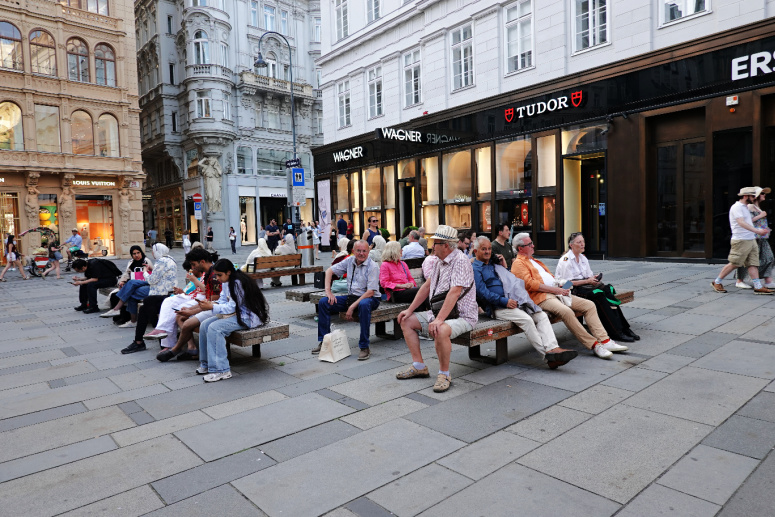
Taking a rest on Graben Street.

Kohlmarkt was an intersting street. Here were many high-end stores like Louis Vuittan and Cartier. As we walked closer to Michael Plaza, the soft, deep sound of a stringed instrument floated like sweet aroma. In the background came the clacking of horse's hooves on the cobble-stoned street.

At Michaelerplatz, not only did we find the double bass player, but also a fragment of Roman ruins inside an enclosed viewing area. Below us we saw the bricked walls of a house and the arch of a door. A small stone canal led to the house. It always amazes me how ruins of the past are located so far below the surface.

Man plays a double bass at Michaelerplatz.

Roman ruins in the center of Vienna.

People-watching in Vienna.

Adjacent to the plaza stood St. Michael's Church. It was smaller and less flamboyant than many of its neighbors. We walked inside and found a mostly dark and near empty interior. A lone lady knelt at a pew and prayed. We quietly circled to the sides, admiring the artistry of the paintings and sculptures. One in particular caught my attention: a figure of Christ, after his crucifixion, being laid on a cloth by two of his disciples.
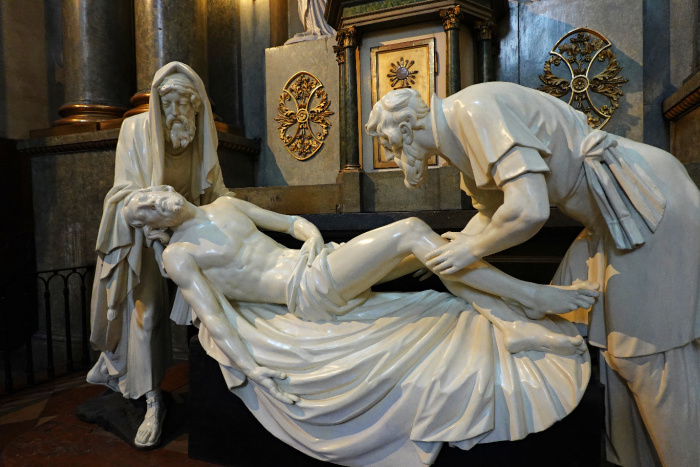
Inside St. Michael's Church.

St. Michael's Church in Michaelerplatz.

I should mention that it was much hotter and humid than we expected. Except for the occasional cross-breeze, or dampness of a church, we suffered from this pleasant heat. I say “pleasant” because, after all, we were in Vienna.

To alleviate this inconvenience, we found an ice cream shop. We had several Euros and we had to use them up. We sat at the base of a fountain, along with a couple-dozen strangers. We ate our ice cream cones as we people-watched. By the time I got to the bottom the treat was melting and the waffle cone crumbling. It still hit the spot.


By now dusk was settling in and the hue on the cathedral and other buildings was changing. Some of the places, like the carousel, now had on their lights. People wore a variety of clothing, including women now wearing evening dresses.

We returned to the souvenir shop, one of the biggest I'd ever seen. It had two stories and an endless supply of magnets, postcards, t-shirts, hand bags, small figurines of Viennese landmarks, and a plethora of other items.

St. Peter's Church.

The evening wore on and we knew that soon we'd need to return to our hotel to catch a morning flight. I had one last request, and that was to eat a wiener schnitzel while in Vienna. "Wien" is the German name for "Vienna."

I had a restaurant in mind on a street down from St. Stephen's Plaza. It was the Figlmüller and claimed to be the original home of the wiener schnitzel. But as we met the server at the doorway, we learned they had no tables available.

We moved to another place around the corner, but there was a line out the door. Then, Jenelle found a place down the street. Immediately we were seated and handed a menu.

Maybe they'd never heard of air conditioning in Austria. It was stuffy. No fans to blow the air, but at least the windows were open. The restaurant seemed to be dominated by shades of the color red, and had a feel from the 1920's.

Kaffee Alt Wien.

It didn't take long to decide what I wanted. It came in either pork, veal or chicken, and since I had eaten neither veal nor wiener schnitzel in my lifetime, that's what I chose.

It came with two schnitzels, a side of cranberry sauce, and a small bowl of parsley potatoes. It looked exactly like all the picture's I'd seen.

To make wiener schnitzel one has to pound and flatten the meat, then deep-fry it in batter.⸺It tasted how I thought it would, largely dominated by the taste and texture of the batter. I thought it was a little on the dry side, but was improved when accompanied with the cranberry sauce. I followed each bite with a chunk of buttery parsley potatoes.  It was a good compliment.

Wiener schnitzel. 

Our evening was now over. We lazily walked toward our hotel, taking everything in. It was now dark, but the city still buzzed with life. We passed a group of over a dozen couples waltzing to classical music. We watched in amazement as the couples moved in step, their legs and arms knowing exactly what to do and where to go. We both agreed that this was a lost art in the States.

We were both beat and feeling bloated from force-feeding ourselves all this “cultural” food. We were ready to get back to the hotel and sleep. But our evening in Vienna would never escape our minds. What a beautiful, pleasant and vibrant city! ♠

Evening of waltzing in Vienna.